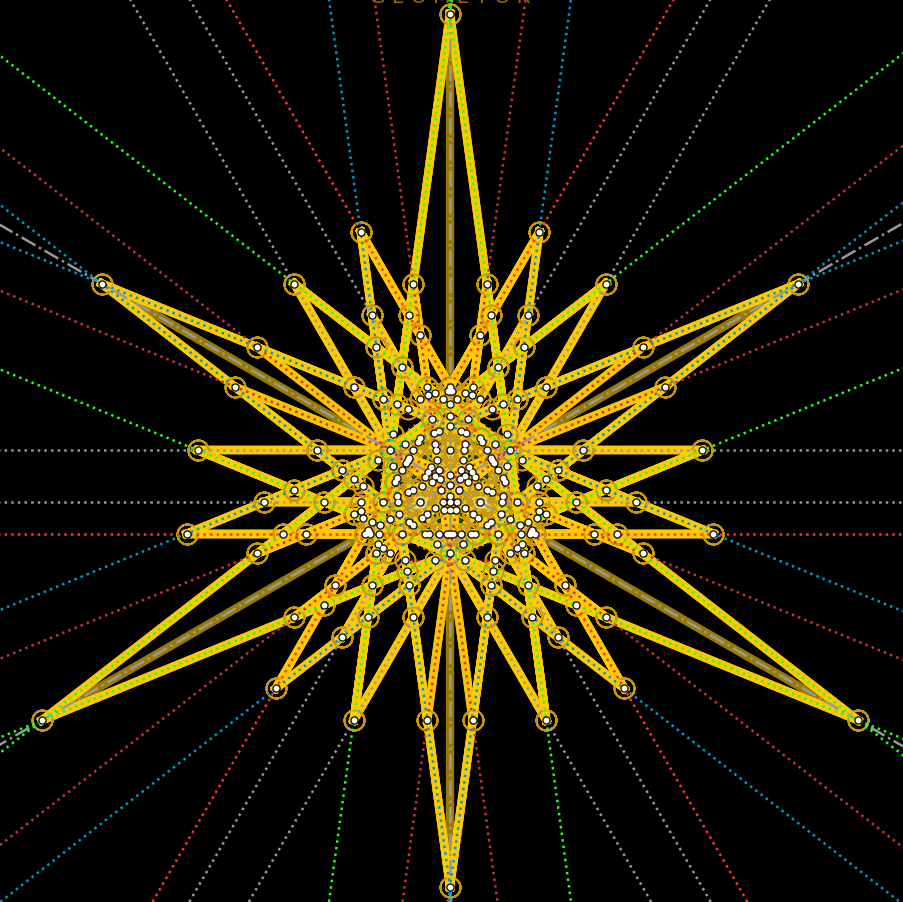
Static and Dynamic Symmetry in Nature and Greek Art — Summary
Analytical Synopsis — Dynamic Symmetry: The Greek Vase (1920) & The Diagonal (1919–1920)
Overview of Section I
In the opening texts of Dynamic Symmetry: The Greek Vase (hambidge:1920-vase) and The Diagonal (hambidge:1920-diagonal), Jay Hambidge articulates the core dichotomy of proportional design:
Static Symmetry: Passive, fixed-unit proportion grounded in regular polygons (squares, equilateral triangles, hexagons) and linear modular measurement. It appears in mineral crystals, diatoms, radiolaria, and Roman, Byzantine, Gothic, and modern decorative art.
Dynamic Symmetry: Active, organic proportion grounded in logarithmic shell growth, leaf-distribution (phyllotaxis), and Euclidean area commensurability. Known historically only to Egypt and classical Greece.
The Egyptian Harpedonaptae: Traces the empirical origins of survey geometry to the 3–4–5 right-angled rope-stretching (cording of the temple), transmitted to Greece in the 6th–7th centuries BCE and perfected as practical and Euclidean geometry (euclid:elements).