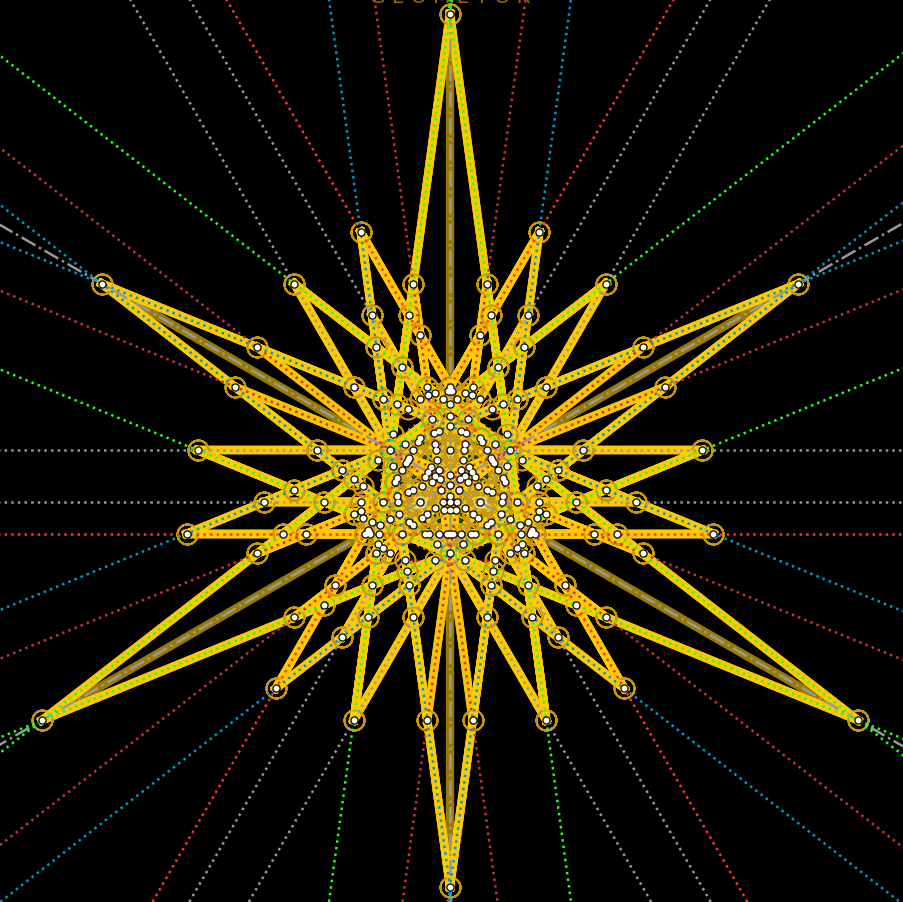
The Dynamic Symmetry of the Plant (Sunflower Phyllotaxis)
Jay Hambidge — The Diagonal (Yale University Press, Vol. I, No. 1, Nov. 1919, pp. 3–7)
Phyllotaxis and the Summation Series
f. Diagonal pp. 3–5 · p. 3It has long been known that a peculiar series of numbers is connected with the phenomenon of the orderly distribution of the leaves of plants. The series is: $1, 2, 3, 5, 8, 13, 21, 34, 55, 89, 144$, etc. This is called a summation series from the fact that each term is composed of the sum of the two preceding terms. For those who may be interested in the subject from the botanical standpoint reference is made to the elaborate work of Professor A. H. Church of Oxford on Phyllotaxis in Relation to Mechanical Laws (church:1904). This series of numbers in reality represents the symmetry of the plant in the sense that the word is used as “analogy,” which is its Greek meaning. From this series we obtain the entire machinery of dynamic symmetry, which applies not only to the architecture of the plant but to the architecture of man.
This summation series of numbers, because of its character, represents a ratio, i.e., it is a geometrical progression. This ratio may be obtained by dividing one term into another, such as $34$ into $55$. The series does not represent the phenomenon exactly, but only so far as it is representable by whole numbers. A much closer representation would be obtained by a substitute series where the cascade ratio is $: 1.618034\dots$ (the golden ratio $\phi = \frac{1 + \sqrt{5}}{2}$).
In the sunflower head used by Professor Church to exhibit the phyllotaxis phenomena, the seed pods are distributed in a rhythmic, intersecting series of curves. Closer inspection shows that these curves are logarithmic or equiangular spirals arrangeable in two intersecting systems winding in opposite directions (parastichies). A normal sunflower disk five or six inches in diameter will exhibit $55$ curves winding in one direction and $89$ crossing them in the other; a smaller head exhibits $34$ and $55$; a very large head $89$ and $144$. Each cross-curve pair consists of two adjacent terms of the summation series, and the seeds themselves expand radially from the center by gnomonic enlargement so that their rhombic packing meshes preserve constant angular form from center to rim.