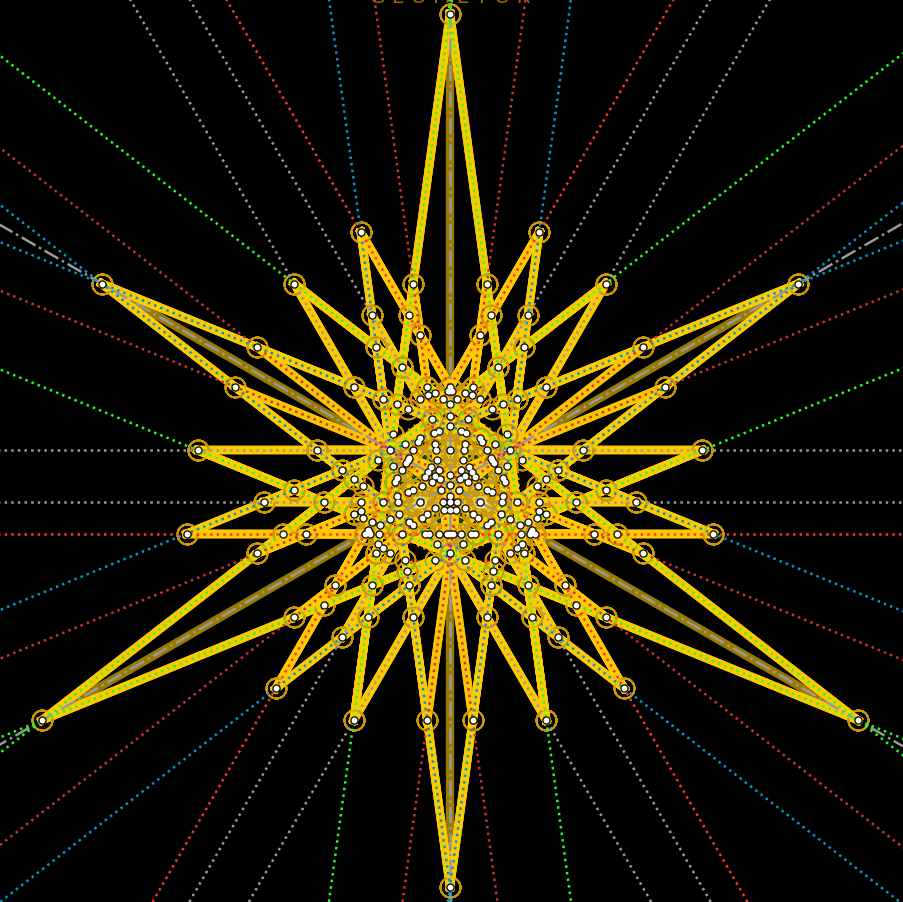
Fourth Section: The Nine-Point Circle & Feuerbach’s Tangency Theorem (§§ 54–60)¶
Karl Wilhelm Feuerbach — Properties of Several Remarkable Points of the Rectilinear Triangle (1822, pp. 37–41, Tab. II Fig. 7)
Section IV forms the historical climax of the entire monograph. Feuerbach establishes that the circumcenter L = X(5) of the orthic triangle MNP bisects the segment KO (§§ 54–55), proves that circle (L, R/2) bisects all three sides of the triangle (§ 56), and proves his immortal Theorem (§ 57): circle (L, R/2) touches the incircle internally at X(11) and the three excircles externally at Fa, Fb, Fc! He closes with the distance sums from L (§§ 58–59) and the harmonic Euler line range (O, G; L, K) = -1 (§ 60).
Sections¶
§§ 54–57: Feuerbach’s Nine-Point Circle Tangency Theorem
§ 54 (Relation KO = 2 OL): Let \(L\) [X5] be taken for the center of the circle [(MNP)] circumscribed about the orthic triangle \(MNP\), whose radius was found (§ 26) equal to \(\tfrac{1}{2}R\), and draw \(OL\). Because \(O\) is simultaneously the center of the circle inscribed in \(\triangle MNP\) (inradius \(\rho\)), Euler’s formula (§ 49) applied to \(\triangle MNP\) immediately gives
§§ 58–60: Linear & Quadratic Center Sums and the Centroid G on KO
§ 58 (Sum of Center Distances from L): Summing \(LS, LS', LS'', LS'''\) via (§ 5) \(r' + r'' + r''' - r = 4R\):