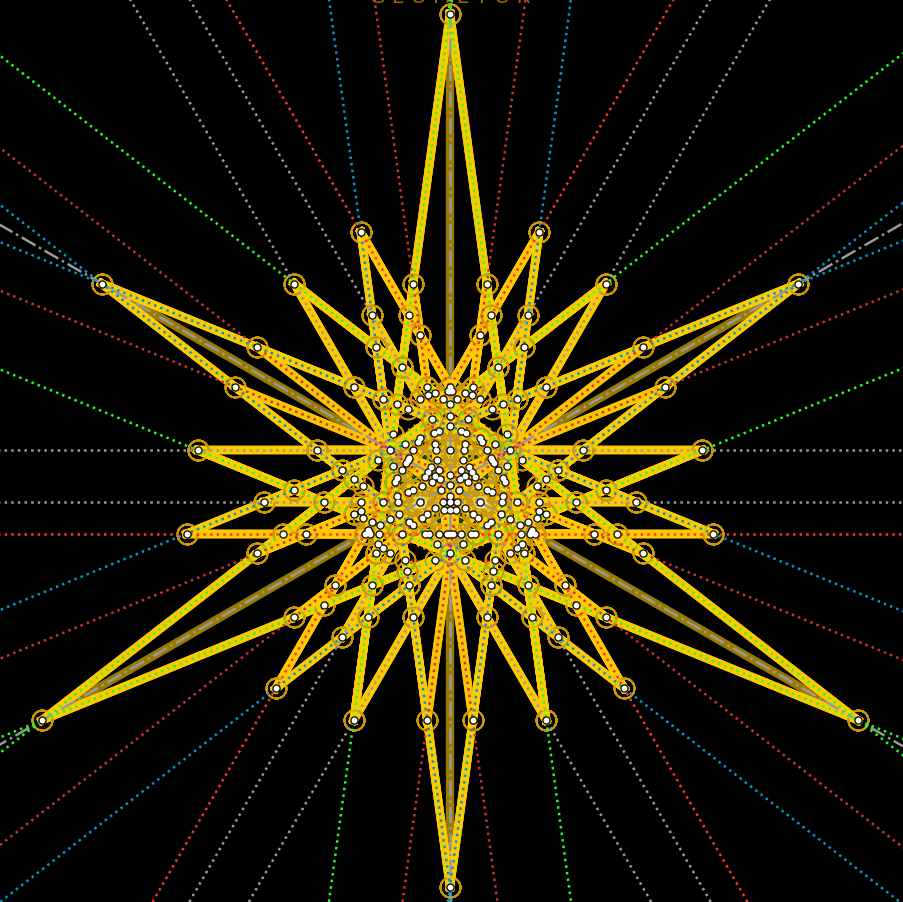
Second Section: The Orthocenter, Orthic Triangle & Inradius ρ (§§ 19–48)¶
Karl Wilhelm Feuerbach — Properties of Several Remarkable Points of the Rectilinear Triangle (1822, pp. 15–32, Fig. 2–5)
Section II investigates the orthocenter O = X(4) and Fagnano’s minimal-perimeter orthic triangle MNP (§ 19). Feuerbach introduces the signed orthic inradius rho = 2R cos alpha cos beta cos gamma as a fundamental third radius invariant (§ 24), discovers that the circumradius of MNP is R/2 (the nine-point radius, § 26), expresses the side-square sum as 8R^2 + 4rho R (§ 27), and proves that the orthocentric sub-triangles BCO, ACO, ABO all share circumradius R (§ 33) and constant power 2rho R (§ 35).
Sections¶
§ 19: Fagnano’s Minimal-Perimeter Orthic Triangle MNP
When from the three vertices of any triangle \(ABC\) one drops upon its opposite sides the perpendiculars \(AM, BN, CP\)—which, as is well known, intersect in one and the same point \(O\) [X4]—the feet of these perpendiculars [M, N, P] determine a triangle \(MNP\) [orthic triangle], which is remarkable because among all triangles inscribed in triangle \(ABC\) it possesses the least perimeter [Footnote: Fagnano perhaps first taught this in the memoir Problemata quaedam ad methodum max. et min. spectantia, Acta Erud., June 1775]. It will therefore not be without interest to consider this triangle more closely, and above all to determine its perimeter and area, together with their ratios to the perimeter and area of the given triangle \(ABC\).
§§ 23–28: Area of ΔMNP, the Orthic Inradius ρ, and Circumradius ½R
§ 23 (Area of ΔMNP): Since \(\triangle ANP = \Delta\cos^2\alpha\), \(\triangle BMP = \Delta\cos^2\beta\), \(\triangle CMN = \Delta\cos^2\gamma\) and \(1 - (\cos^2\alpha + \cos^2\beta + \cos^2\gamma) = 2\cos\alpha\cos\beta\cos\gamma\), the area of the orthic triangle in an acute triangle \(ABC\) is
§§ 30–36: Exradii of ΔMNP and Altitude-Segment Products Through O
§§ 30–31 (p. 21): The perpendiculars \(Am, Bn, Cp\) dropped from \(A, B, C\) onto the opposite sides of \(\triangle MNP\) are the three exradii \(\rho^{(1)}, \rho^{(2)}, \rho^{(3)}\) of \(\triangle MNP\):
§§ 41–48: Corner Orthocenters M’, N’, P’ and Circumcenter Sub-Circles
§§ 41–42 (p. 28): Let \(M', N', P'\) be the orthocenters of the corner triangles \(\triangle ANP, \triangle BMP, \triangle CMN\). Since \(AO\) is the diameter of circle \((ANP)\), \(AM' = AO\cos\alpha = 2R\cos^2\alpha\), whence: