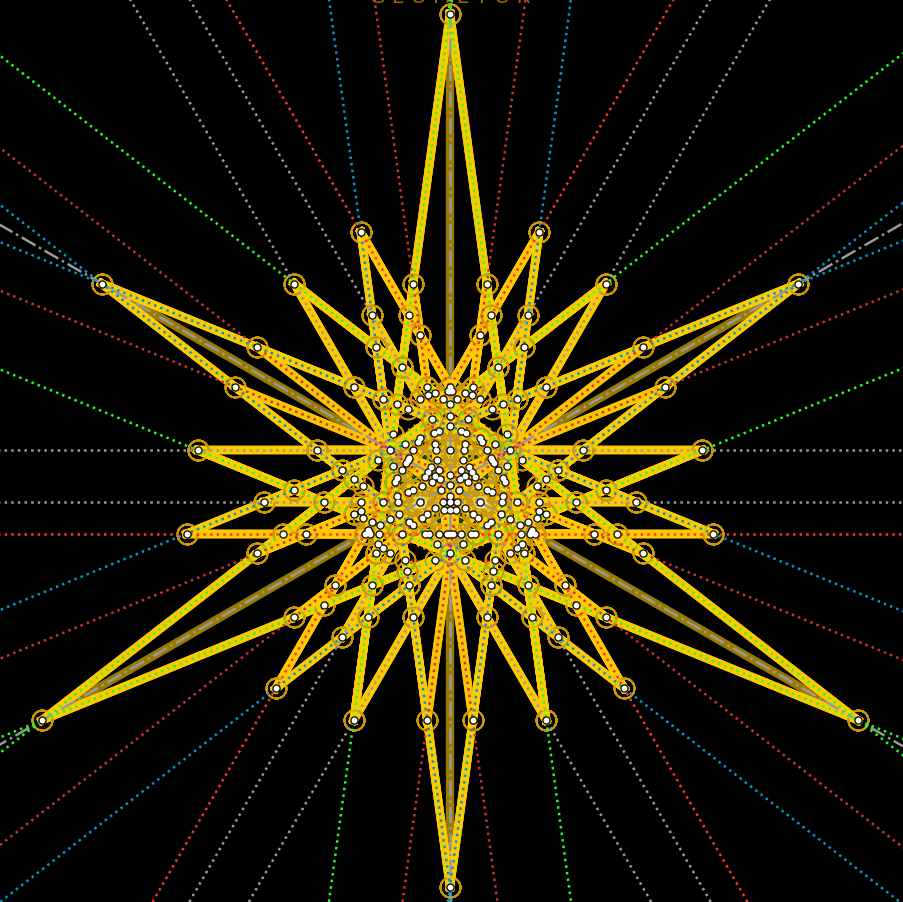
§§ 3–7: Symmetric Polynomial Laws Among the Four Tritangent Radii¶
§ 3 (Pairwise Exradius Sum): Multiplying the values of \(r', r'', r'''\) two by two and summing the products yields
\[r'r'' + r'r''' + r''r''' = \frac{4\Delta^2(a + b + c)}{(-a + b + c)(a - b + c)(a + b - c)} = \frac{1}{4}(a + b + c)^2,\]that is, the sum of the three rectangles formed by the three exradii taken in pairs equals the square on the semiperimeter \(s = \tfrac{1}{2}(a+b+c)\).
§ 4 (Reciprocal & Volume Relation): Substituting \(a+b+c = \frac{2\Delta}{r}\) and \(\Delta^2 = rr'r''r'''\) gives
\[r'\,r''\,r''' = r\left(r'r'' + r'r''' + r''r'''\right) = \frac{1}{2}(a + b + c)\Delta \qquad \Longleftrightarrow \qquad \frac{1}{r'} + \frac{1}{r''} + \frac{1}{r'''} = \frac{1}{r}.\]§ 5 (Linear Sum of Exradii, pp. 3–4): Adding \(r', r'', r'''\) via the algebraic identity \((a+b+c)\big[(-a+b+c)(a-b+c) + (-a+b+c)(a+b-c) + (a-b+c)(a+b-c)\big] = (-a+b+c)(a-b+c)(a+b-c) + 8abc\) and introducing the circumradius \(R = \frac{abc}{4\Delta}\) yields
\[r' + r'' + r''' = \frac{(-a+b+c)(a-b+c)(a+b-c) + 8abc}{8\Delta} = r + 4R.\]The sum of the three exradii equals the inradius increased by twice the diameter of the circumcircle.
§ 6 (All Six Pairwise Products & Side-Squares): Combining \(r(r'+r''+r''') = ab + ac + bc - \frac{1}{4}(a+b+c)^2\) with § 3 by addition and subtraction produces the twin symmetric laws:
\[\begin{split}rr' + rr'' + rr''' + r'r'' + r'r''' + r''r''' &= ab + ac + bc, \tag{1} \\ r'r'' + r'r''' + r''r''' - r(r' + r'' + r''') &= \frac{1}{2}(a^2 + b^2 + c^2). \tag{2}\end{split}\]§ 7 (Sum of Exradius Squares): From \(r'^2 + r''^2 + r'''^2 = (r'+r''+r''')^2 - 2(r'r''+r'r'''+r''r''')\) and §§ 3, 5:
\[r'^2 + r''^2 + r'''^2 = (r + 4R)^2 - \frac{1}{2}(a + b + c)^2.\]