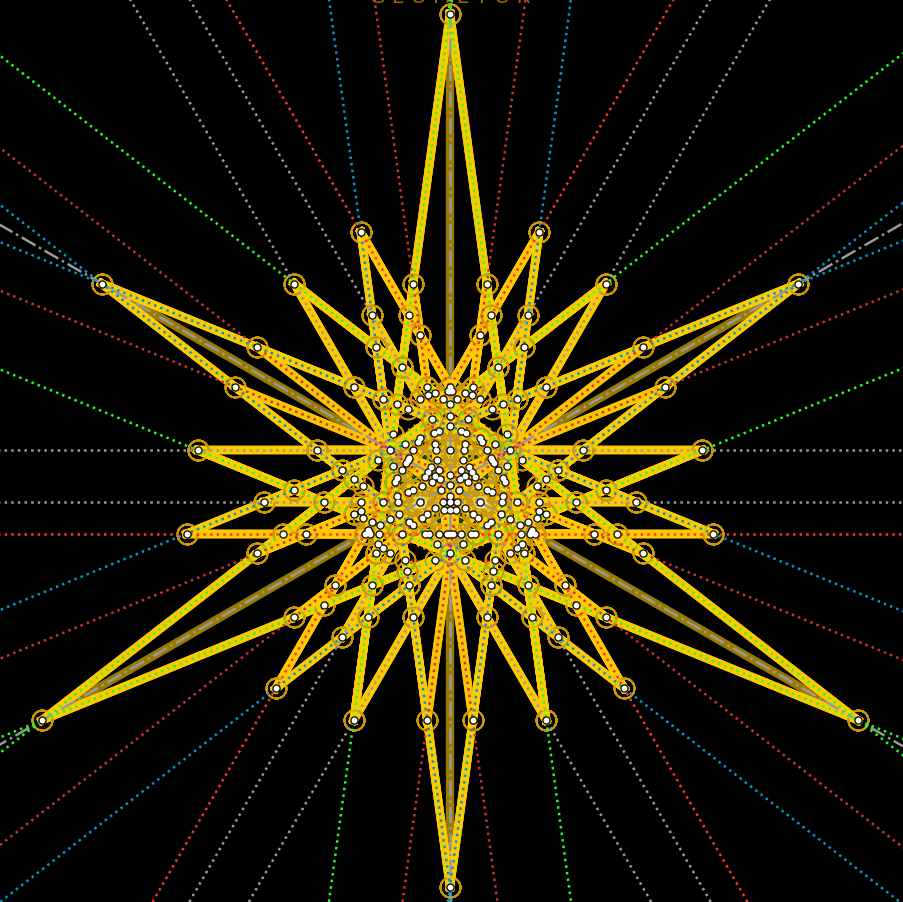
Properties of Remarkable Points of the Rectilinear Triangle¶
Eigenschaften einiger merkwürdigen Punkte des geradlinigen Dreiecks — Karl Wilhelm Feuerbach (1822)
geometor.feuerbach.euler and geometor.feuerbach.tangency.“In every triangle, the circle which passes through the feet of its altitudes simultaneously meets the sides of the same at their midpoints. […] The circle which passes through the feet of the altitudes of a triangle touches all four circles touching the three sides of the same: namely, it touches the internally touching circle internally, whereas it touches each of the externally touching circles externally.”
—Karl Wilhelm Feuerbach, Eigenschaften, §§ 56–57 (p. 38)
Table of Contents¶
Preface — Karl Buzengeiger’s Preface (pp. III–XVI, Freiburg, 16 March 1822) (English · German · Summary · Notes)
Mathematics contemplated as Wissenschaft (Euclid’s Elements) versus Kunst (Greek geometric Analysis in Euclid's Data, Apollonius, Robert Simson’s restorations, and Diophantus), reflections on combinatorial analysis and factorials, and Buzengeiger’s commendation of his Freiburg pupil Feuerbach.
Section I — The Four Tritangent Circle Centers (§§ 1–18, pp. 1–14) (English · German · Summary · Notes)
Incenter \(S = X(1)\) and excenters \(S', S'', S'''\) as orthocentric system, L'Huilier’s symmetric law \(rr'r''r''' = \Delta^2\) (§ 2), \(r'r'' + r'r''' + r''r''' = s^2\) (§ 3), \(r' + r'' + r''' = r + 4R\) (§ 5), contact triangles \(\delta, \delta', \delta'', \delta'''\) (§ 8), and the six mutual center-chord laws \(A^2 + A'^2 = B^2 + B'^2 = C^2 + C'^2 = 16R^2\) (§§ 12–18).
Section II — Orthocenter, Orthic Triangle & Inradius ρ (§§ 19–48, pp. 15–32) (English · German · Summary · Notes)
Orthocenter \(O = X(4)\) as incenter of Fagnano’s minimal-perimeter orthic triangle \(\triangle MNP\) (§ 19), introduction of the orthic inradius \(\rho = 2R\cos\alpha\cos\beta\cos\gamma\) (§§ 23–25), orthic circumradius \(\tfrac{1}{2}R\) (§ 26), \(r^2 + r'^2 + r''^2 + r'''^2 = 4R(2R - \rho)\) (§ 28), and the equal circumradii \(R' = R'' = R''' = R\) of \(\triangle BCO, \triangle ACO, \triangle ABO\).
Section III — Distances from Circumcenter & Orthocenter (§§ 49–53, pp. 33–36) (English · German)
Citation of Euler (1765) and Fuß (1797) for \(\overline{KS}^2 = R^2 - 2rR\) (§ 49), sum of circumcenter quadrances \(\sum \overline{KS_i}^2 = 12R^2\) (§ 50), incenter quadrance \(\overline{OS}^2 = 2r^2 - 2\rho R\) (§ 51), and the fundamental distance \(\overline{KO}^2 = R^2 - 4\rho R\) (§ 53).
Section IV — The Nine-Point Circle & Feuerbach’s Tangency Theorem (§§ 54–60, pp. 37–41) (English · German · Summary · Notes)
Nine-point center \(L = X(5)\) bisecting \(KO\) (§§ 54–55), the nine concyclic points (§ 56), § 57 Feuerbach’s Theorem (\(LS = \tfrac{1}{2}R - r\) at \(X(11)\) and \(LS^{(k)} = \tfrac{1}{2}R + r^{(k)}\)), \(LS + LS' + LS'' + LS''' = 6R\) (§ 58), \(\sum LS_i^2 = R(13R - 4\rho)\) (§ 59), and the harmonic range \((O, G; L, K) = -1\) (§ 60).
Section V — Proportional Contact Triangles & Excentral Orthocenter (§§ 61–87, pp. 41–55) (English · German · Summary · Notes)
Geometric-mean area proportionals \(\mu^{(k)} : \delta^{(k)} = \delta^{(k)} : \Delta\) (§ 63), the five-triangle area law \(\mu + \mu' + \mu'' + \mu''' + \triangle MNP = 2\Delta\) (§ 64), half-perimeter law (§ 65), corner-circle inradii (§§ 71–73), and § 87 establishing that \(S = X(1)\) is the orthocenter of \(\triangle O'O''O'''\).
Synthetic Appendix — Pure Euclidean Proofs of Nine Core Propositions (Propositions 1–9, pp. 56–62) (English · German · Summary · Notes)
Pure synthetic demonstrations grounded in Euclid's Elements Books I, III, and VI, culminating in 5. Satz (\(\triangle MNP : \triangle ABC = \rho : R\)), 6. Satz (\(CO \cdot OP = 2R\rho\)), 7. Satz (\(a^2 + b^2 + c^2 = 8R^2 + 4\rho R\)), and verbatim 9. Satz proving \(LM = LN = LP = \tfrac{1}{2}R\) for the midpoint \(L\) of \(OK\).
Preface (Vorrede) by Karl Buzengeiger (March 1822)
I. Mathematics as Science (Wissenschaft) and as Art (Kunst)
First Section: On the Centers of the Four Tritangent Circles (§§ 1–18)
Section I establishes the metric foundations of the four tritangent circles (one incircle, three excircles). Feuerbach discovers that triangle ABC is the orthic (pedal) triangle of the excentral triangle S’S’’S’’’, with incenter S as its orthocenter (§ 1). He proves L’Huilier’s theorem rr’r’’r’’’ = Delta^2 (§ 2), establishes elementary symmetric polynomial identities among the exradii (§§ 3–7), proves that contact triangle areas scale linearly with the tritangent radii (§§ 8–11), and deduces the metric laws governing the orthocentric quadrangle (S, S’, S’’, S’’’) with opposite distance-square sums equal to (4R)^2 = 16R^2 (§§ 12–18).
Second Section: The Orthocenter, Orthic Triangle & Inradius ρ (§§ 19–48)
Section II investigates the orthocenter O = X(4) and Fagnano’s minimal-perimeter orthic triangle MNP (§ 19). Feuerbach introduces the signed orthic inradius rho = 2R cos alpha cos beta cos gamma as a fundamental third radius invariant (§ 24), discovers that the circumradius of MNP is R/2 (the nine-point radius, § 26), expresses the side-square sum as 8R^2 + 4rho R (§ 27), and proves that the orthocentric sub-triangles BCO, ACO, ABO all share circumradius R (§ 33) and constant power 2rho R (§ 35).
Third Section: Distances from the Circumcenter and Orthocenter (§§ 49–53)
Section III determines the exact mutual quadrances between the circumcenter K = X(3), orthocenter O = X(4), and the four tritangent centers S, S’, S’’, S’’’. Feuerbach cites Euler (1765) and Fuß (1797) for KS^2 = R^2 - 2rR (§ 49), proves sum(KS_i^2) = 12R^2 (§ 50), deduces OS^2 = 2r^2 - 2rho R (§ 51), and proves the foundational distance KO^2 = R^2 - 4rho R (§ 53).
Fourth Section: The Nine-Point Circle & Feuerbach’s Tangency Theorem (§§ 54–60)
Section IV forms the historical climax of the entire monograph. Feuerbach establishes that the circumcenter L = X(5) of the orthic triangle MNP bisects the segment KO (§§ 54–55), proves that circle (L, R/2) bisects all three sides of the triangle (§ 56), and proves his immortal Theorem (§ 57): circle (L, R/2) touches the incircle internally at X(11) and the three excircles externally at Fa, Fb, Fc! He closes with the distance sums from L (§§ 58–59) and the harmonic Euler line range (O, G; L, K) = -1 (§ 60).
Fifth Section: Comparative Proportions Among Derived Triangles (§§ 61–87)
Section V establishes harmonic and homothetic proportions among the contact triangles and orthic triangles. Feuerbach proves that the orthic triangle MNP is the mean proportional between triangle ABC and the contact triangle def (§ 61), derives the fourfold geometric-mean chain mu : delta = delta : Delta (§ 63), proves the five-triangle area partition law mu + mu’ + mu’’ + mu’’’ + area(MNP) = 2Delta (§ 64), and concludes in § 87 that incenter S is the orthocenter of triangle O’O’’O’’’.
Synthetic Appendix: Pure Euclidean Proofs of Nine Theorems (pp. 56–62)
The Synthetischer Anhang demonstrates the foundational metric properties of the orthocenter, orthic triangle, and nine-point circle purely synthetically from Euclid’s Elements Books I–IV and VI without coordinate algebra or trigonometry. Feuerbach proves CO = 2KD (1. Satz), AB^2 + CO^2 = 4R^2 (2. Satz), the orthic perimeter and area ratios (3.–5. Satz), altitude chord rectangle CO · OP = 2Rrho (6. Satz), sum of side squares (7. Satz), Schwarz reflection unfolding of the orthic perimeter (8. Satz), and pure Euclidean proof of the nine-point circle bisecting OK with radius R/2 and explicit Euler midpoint antipodes (9. Satz).