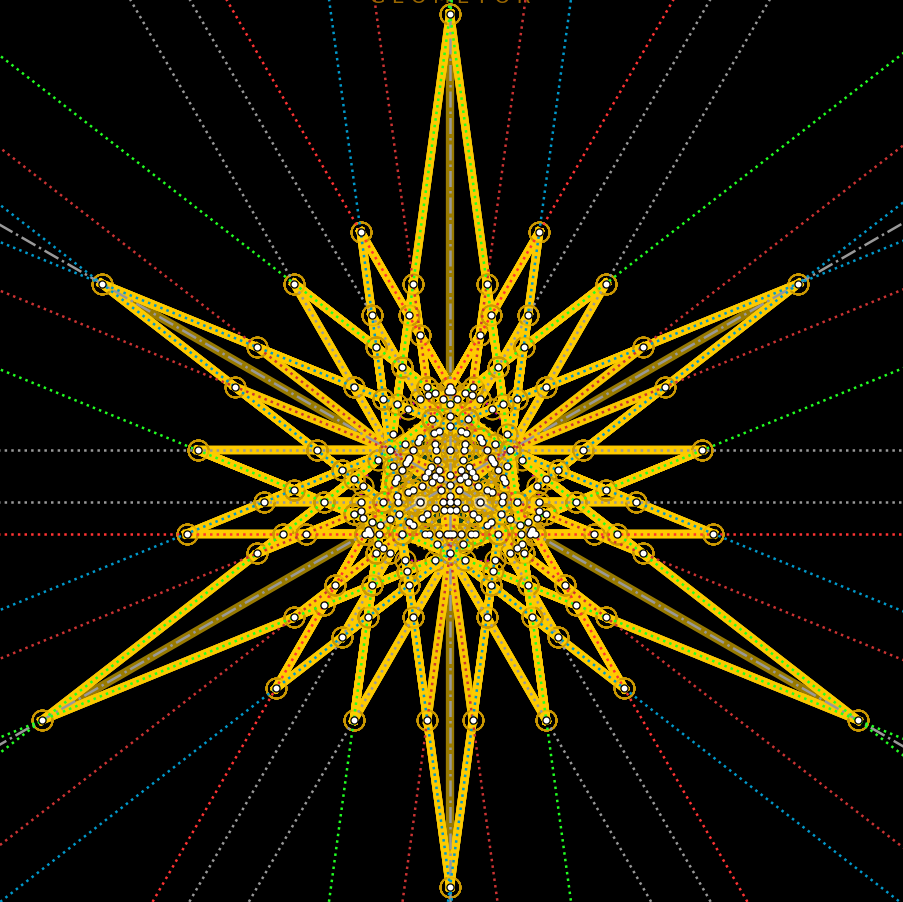
T_4 • Harmonic Conjugate & Cross-Ratio
Category: Transformations & Conjugacies
Four collinear centers (A, B; C, D) form a harmonic range when C and D divide segment AB internally and externally in the same ratio, yielding cross-ratio −1.
Primary Construction & Central Lines
Key Properties & Sequenced Operations
Definition (PROJECTIVE INVARIANCE):
(A, B; C, D) = (AC / CB) : (AD / DB) = −1— Harmonic Range: On the Euler line through X5, internal and external division of X3 and X4 with X2 links the medial triangle M_a M_b M_c and nine-point circle. (Cross-ratio (A, B; C, D) = −1 is preserved under every projective collineation.)Coordinate & Algebraic Law (HARMONIC MEAN):
Euler Range (X_3, X_4; X_2, X_5) = −1— Homogeneous Linear Combination: If C = p·A + q·B, then its harmonic conjugate with respect to A and B is D = p·A − q·B, satisfying 2/AB = 1/AC + 1/AD. (On the Euler line: X2 : X5 divide X3 X4 in ratios 1 : 2 and 1 : −1.)Central Line Incidences (SIMILICENTER DUALITY):
Euler Line {2, 3, 4, 5} & Feuerbach Line {1, 5, 11, 12}— Collection 1 Harmonic Axes: The Euler line {2, 3, 4, 5} and Feuerbach line {1, 5, 11, 12} meet at the Nine-Point Center X5. (Internal and external centers of similitude of any two circles are harmonic conjugates with respect to their centers.)Collection 1 Network (APOLLONIAN HARMONICS):
(X_2, X_4; X_3, X_5) = −1 • (X_1, X_5; X_11, X_12) = −1— Harmonic Quartets: Euler centers X2, X3, X4, X5 and Feuerbach centers X1, X5, X11, X12. (On the Brocard axis, (X3, X6; X15, X16) also forms a classical harmonic structure.)