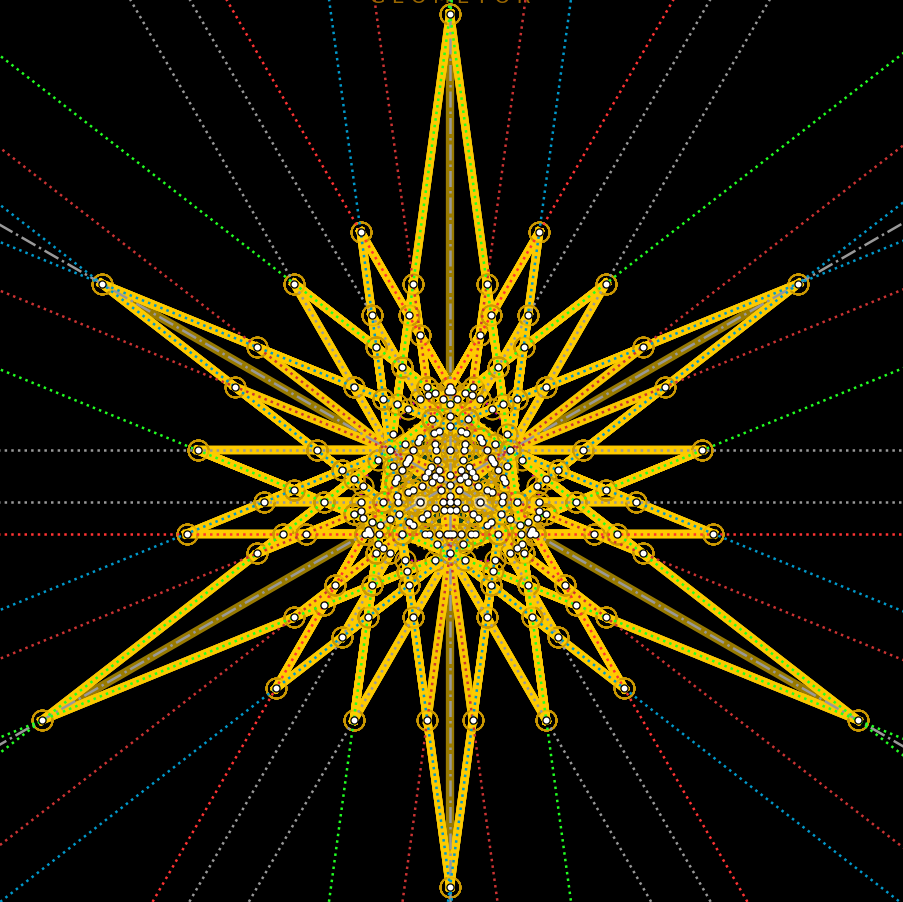
T_6 • The Euler Line
Category: Named Central Lines
Leonhard Euler’s 1765 central line passing through the Centroid X2, Circumcenter X3, Orthocenter X4, and Nine-Point Center X5 of every non-equilateral triangle.
Primary Construction & Central Lines
Key Properties & Sequenced Operations
Definition (EULER (1765) • NOVI COMMENTARII):
Euler Line L(2, 3, 4, 5, 20, 30) • |X_3 X_2| : |X_2 X_5| : |X_5 X_4| = 2 : 1 : 3— The Euler Line: Connects X2, X3, X4, and X5 across the medial triangle M_a M_b M_c and nine-point circle. (On an equilateral triangle, X2, X3, X4, and X5 coincide and the Euler line is indeterminate.)Coordinate & Algebraic Law (EULER INFINITY POINT X30):
Trilinear Equation: sin(2A) sin(B−C) α + sin(2B) sin(C−A) β + sin(2C) sin(A−B) γ = 0— Shinagawa Coefficients: Every Euler center is a linear combination p·X4 + q·X3 with X2 = (1, 2) and X5 = (1, 1). (X30 is the point at infinity of the Euler line; X20 (de Longchamps) is the reflection of X4 in X3.)Central Line Incidences (2 : 1 : 3 SEGMENT RATIOS):
Collinearity {2, 3, 4, 5, 20}— Central Line Spine: The Euler line {2, 3, 4, 5, 20} links the circumcenter, centroid, nine-point center, orthocenter, and de Longchamps point. (X2 trisects X3 X4, while X5 bisects X3 X4.)Collection 1 Network (COLLECTION 1 ANCHOR):
X_3 • X_2 • X_5 • X_4 • X_20— Ordered Euler Sequence: X2, X3, X4, X5, and X20 lie in exact rational ratio along the Euler axis. (Four of the first five centers in Kimberling’s Encyclopedia lie on the Euler line.)