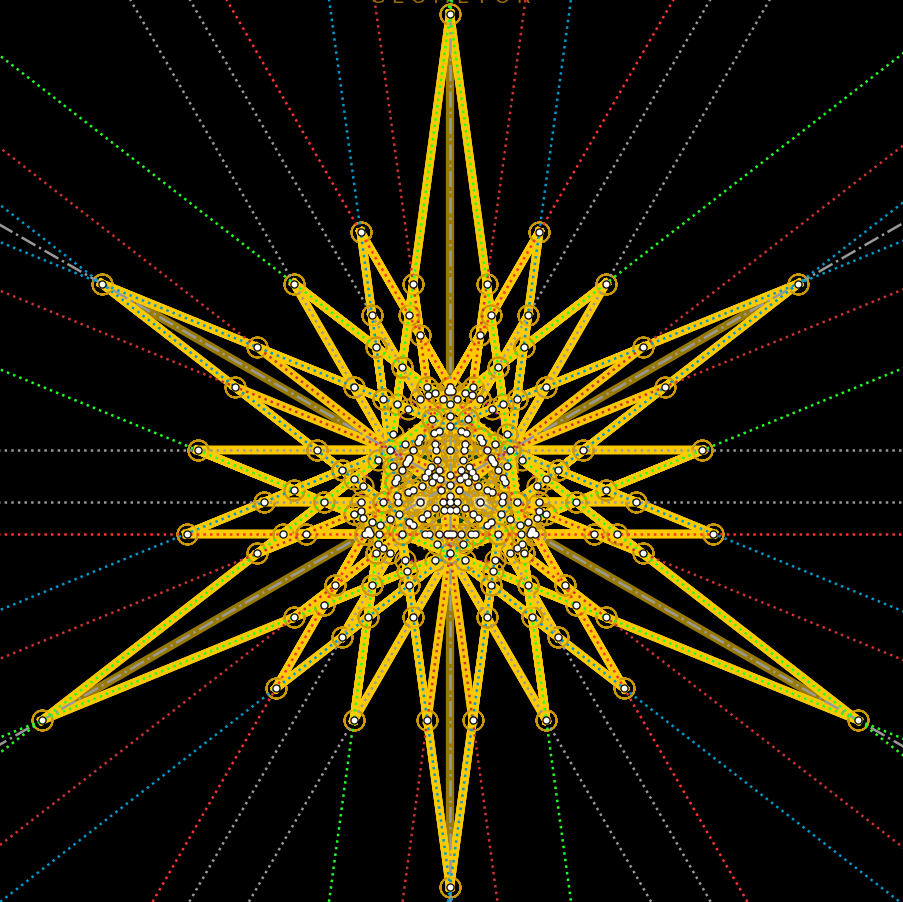
X(60) = ISOGONAL CONJUGATE OF X(12)
Trilinears
\(1/[1 + cos(B - C)] : 1/[1 + cos(C - A)] : 1/[1 + cos(A - B)]\)
\(sec^2 (B/2 - C/2) : :\)
Barycentrics
\(a/[1 + cos(B - C)] : b/[1 + cos(C - A)] : c/[1+ cos(A - B)] Let A'B'C' be the cevian triangle of :ref:`X(21) <X(21)>\). Let A″, B″, C″ be the inverse-in-circumcircle of A’, B’, C’. The lines AA″, BB″, CC″ concur in X(60). (Randy Hutson, October 15, 2018) X(60) lies on these lines: 1,110 21,960 28,81 36,58 59,1101 86,272 283,284 404,662 757,1014 X(60) = isogonal conjugate of X(12) <X(12)>`
Notes
Let A’B’C’ be the cevian triangle of X(21). Let A″, B″, C″ be the inverse-in-circumcircle of A’, B’, C’. The lines AA″, BB″, CC″ concur in X(60). (Randy Hutson, October 15, 2018)
X(60) lies on these lines: 1,110 21,960 28,81 36,58 59,1101 86,272 283,284 404,662 757,1014
X(60) = isogonal conjugate of X(12)
X(60) = isotomic conjugate of X(34388)
X(60) = anticomplement of X(34829)
X(60) = X(58)-cross conjugate of X(270)
X(60) = X(i)-beth conjugate of X(j) for these (i,j): (60,849), (1098,1098)
X(60) = crossdifference of every pair of points on line X(2610)X(4024)
X(60) = perspector of ABC and extraversion triangle of X(59)
X(60) = X(75)-isoconjugate of X(181)
X(60) = trilinear square of X(6727)
X(60) = complement of isogonal conjugate of X(36903)