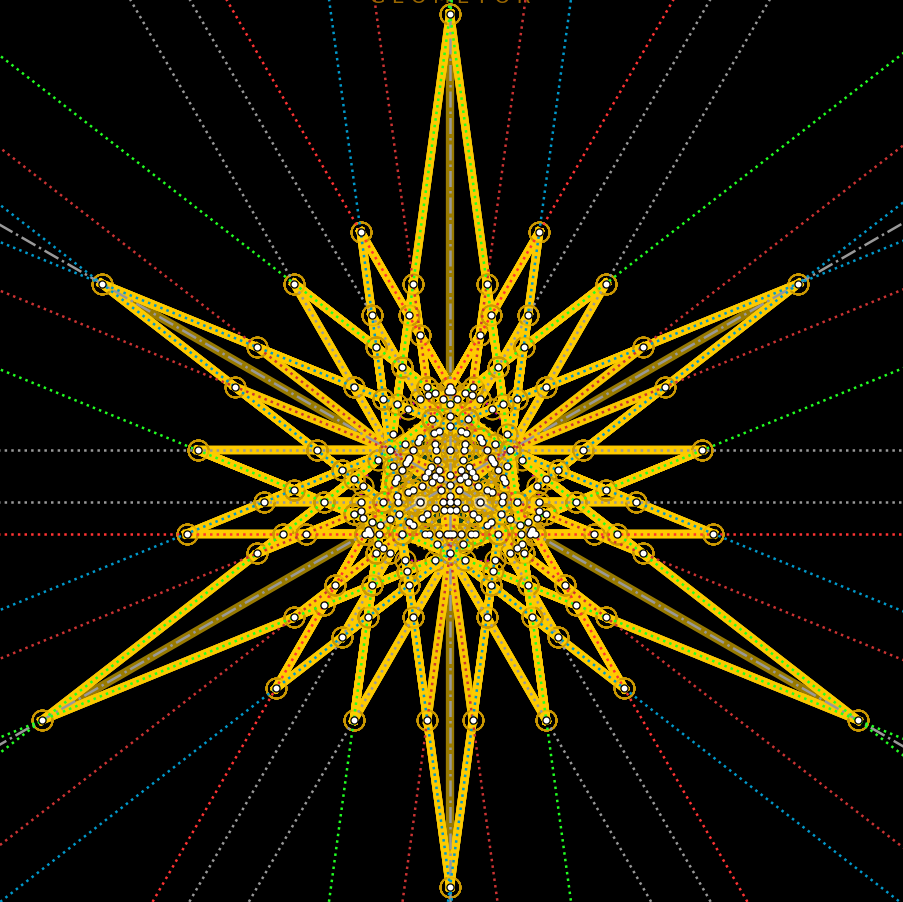
X3758–X3861
Central Triangle Combos Xcom(T) II: Parameterized T(f, g) & Euler Triangles
X3758–X3861 (Central Triangle Combos Xcom(T) II: Parameterized T(f, g) & Euler Triangles) — 16 representative centers (from 104 in collection) constructed on acute reference triangle \((a, b, c) = (5, 6, 7)\) with unit baseline AB = \(1\).
Group Preamble — Central Triangles and More Combos
Many triangle centers can be defined (as just above) by the form Xcom(nT), where T denotes a central triangle. In order to present such centers, it is helpful to introduce the notation T(f(a,b,c), g(b,c,a)) for central triangles. Following TCCT, pages 53-54, suppose that each of f(a,b,c) and g(a,b,c) is a center-function or the zero function, and that one of these three conditions holds:
There are two cases to be considered: If \(g(a,b,c)=g(a\),c,b), then the central triangle T(f(a,b,c), g(b,c,a)) is defined by the following 3x3 matrix (whose rows give homogeneous coordinates for the A-, B-, C- vertices, respectively):
If g(a,b,c) is not equal to g(a,c,b), then the central triangle T(f(a,b,c),g(b,c,a)) is defined by the following 3x3 matrix:
If the homogenous coordinates are chosen to be barycentric, as they are for present purposes, then the new notation for central triangles is typified by these examples:
The vertices of the five Euler triangles lie on the nine-point circle. (See C. Kimberling, “Twenty-one points on the nine-point circle,” Mathematical Gazette 92 (2008) 29-38.) Randy Hutson observes (January 8, 2015) that the 2nd Euler triangle is the complement of the circumorthic triangle, the 2nd Euler triangle is the reflection of the orthic triangle in X5; the 3rd Euler triangle is the complement of the 1st circumperp triangle, the 4th Euler triangle is the complement of the 2nd circumperp triangle; the 4th Euler triangle the triangle whose sidelines are the radical axes of each of the Odehnal tritangent circles (defined at X6176) and the corresponding excircle; the 5th Euler triangle is the complement of the circummedial triangle, and the vertices of the 5th Euler triangle are the intersections, other than midpoints of the sides of ABC, of the nine-point circle and the medians.
The notation T(f(a,b,c),g(b,c,a)) can be used to define several more triangles; in each case, two of the perspectivities can be used to construct the triangle.
T(bc, \(b^{2})\) is perspective to ABC with perspector X6; other such pairs: incentral, X192, excentral, X1045; tangential, X6; anticomplementary, X192
T(-bc, \(b^{2})\) is perspective to ABC with perspector X6; incentral, X2; tangential, X6; T(bc,\(b^{2})\), X6
T(bc, \(c^{2})\) is perspective to ABC with perspector X76; anticomplementary, X8; 4th Brocard, X76, Fuhrmann, X8; cevian <cevian>`(:ref:`X350),X1
T(-bc, \(c^{2})\) is perspective to ABC with perspector X76; cevian(X321),X75; anticevian(X8), X2
\(T(a^{2}\), \(a^{2}\) - \(b^{2})\) is perspective to the medial triangle with perspector X3; tangential , X3; symmedial, X2; cevian(X287), X98
\(T(a^{2}\), \(a^{2}\) - \(c^{2})\) is perspective to the tangential triangle with perspector X25; orthic , X25; medial, X6; 1st Lemoine, X1383; circummedial, X251
\(T(a^{2}\), \(a^{2}\) + \(b^{2})\) is perspective to ABC with perspector X83; medial, X6; 1st Neuberg, X182
\(T(a^{2}\), \(a^{2}\) + \(c^{2})\) is perspective to ABC with perspector X141; medial, X3; 1st Neuberg, X182; \(T(a^{2}\),\(a^{2}\) - \(c^{2})\), X2; cevian(X69), X6; cevian(X76), X2; cevian(X3313),X39
The triangles IT1 and IT2 are triply perspective to ABC (as are T1 and T3). Order-label IT1 as A'B'C'. The three perspectivities are then given by
Peter Moses noted (12/23/2011) that T(bc, \(b^{2})\) is triply perspective to ABC. With T(bc, \(b^{2})\) order-labeled as A'B'C', the three perspectivities with perspectors are as follows:
(This section was added to ETC on 12/23/2011.)

X3758com[T(bc, b2)]

X3759com[T(-bc, b2)]

X3760com[T(-bc, c2)]

X3761com[T(bc, c2)]

X3762com[T(bc, c2)]


X3764com[T(bc, b2)]

X3765com[T(bc, c2)]

X3766com[T(bc, c2)]

X3767com[T(a2, a2 - c2)]

X3768com[T(bc, b2)]


X3772com[T(a2, a2 - c2)]


X3775com[INVERSE(nT(bc, c2))]

X3776com[INVERSE(nT(-bc, c2))]


X3778com[INVERSE(nT(-bc, b2))]

X3779com[T(-bc, b2)]


X3782com[T(-bc, c2)]


X3785com[INVERSE(nT(a2, a2 + b2))]


X3788comT(a2, a2 - b2))]


X3796com[INVERSE(nT(a2, a2 + c2))]


X3800com[INVERSE(nT(a2, a2 + b2))]


X3805com[INVERSE(nT(bc,c2))]


X3808com[INVERSE(nT(-bc, c2))]


X3810com[INVERSE(nT(-bc, c2))]

X3811com(EULER TRIANGLE)

X3812com(4th EULER TRIANGLE)


X3814com(EULER TRIANGLE)

X3815com(5th EULER TRIANGLE)

X3816com(3rd EULER TRIANGLE)

X3817com(3rd EULER TRIANGLE)

X3818com(EULER TRIANGLE)

X3819com(2nd EULER TRIANGLE)


X3821com(4th EULER TRIANGLE)

X3822com(3rd EULER TRIANGLE)

X3823com(4th EULER TRIANGLE)


X3826com(3rd EULER TRIANGLE)

X3827com(2nd EULER TRIANGLE)

X3828com(4th EULER TRIANGLE)


X3830com(EULER TRIANGLE)


X3832com(EULER TRIANGLE)

X3833com(4th EULER TRIANGLE)

X3834com(3rd EULER TRIANGLE)

X3835com(3rd EULER TRIANGLE)

X3836com(4th EULER TRIANGLE)

X3837com(3rd EULER TRIANGLE)

X3838com(3rd EULER TRIANGLE)

X3839com(EULER TRIANGLE)

X3840com(3rd EULER TRIANGLE)


X3842com(4th EULER TRIANGLE)

X3843com(EULER TRIANGLE)


X3845com(EULER TRIANGLE)

X3846com(3rd EULER TRIANGLE)


X3848com(3rd EULER TRIANGLE)

X3849com(5th EULER TRIANGLE)

X3850com(EULER TRIANGLE)

X3851com(EULER TRIANGLE)


X3853com(EULER TRIANGLE)

X3854com(EULER TRIANGLE)
As a point on the Euler line, X3854 has Shinagawa coefficients \((3, 8)\).

X3855com(EULER TRIANGLE)

X3856com(EULER TRIANGLE)
As a point on the Euler line, X3856 has Shinagawa coefficients \((5, 17)\).

X3857com(EULER TRIANGLE)
As a point on the Euler line, X3857 has Shinagawa coefficients \((5, 13)\)

X3858com(EULER TRIANGLE)
As a point on the Euler line, X3858 has Shinagawa coefficients \((3, 11)\)

X3859com(EULER TRIANGLE)
As a point on the Euler line, X3859 has Shinagawa coefficients \((7, 19)\)

X3860com(EULER TRIANGLE)
As a point on the Euler line, X3860 has Shinagawa coefficients \((7, 27)\)
