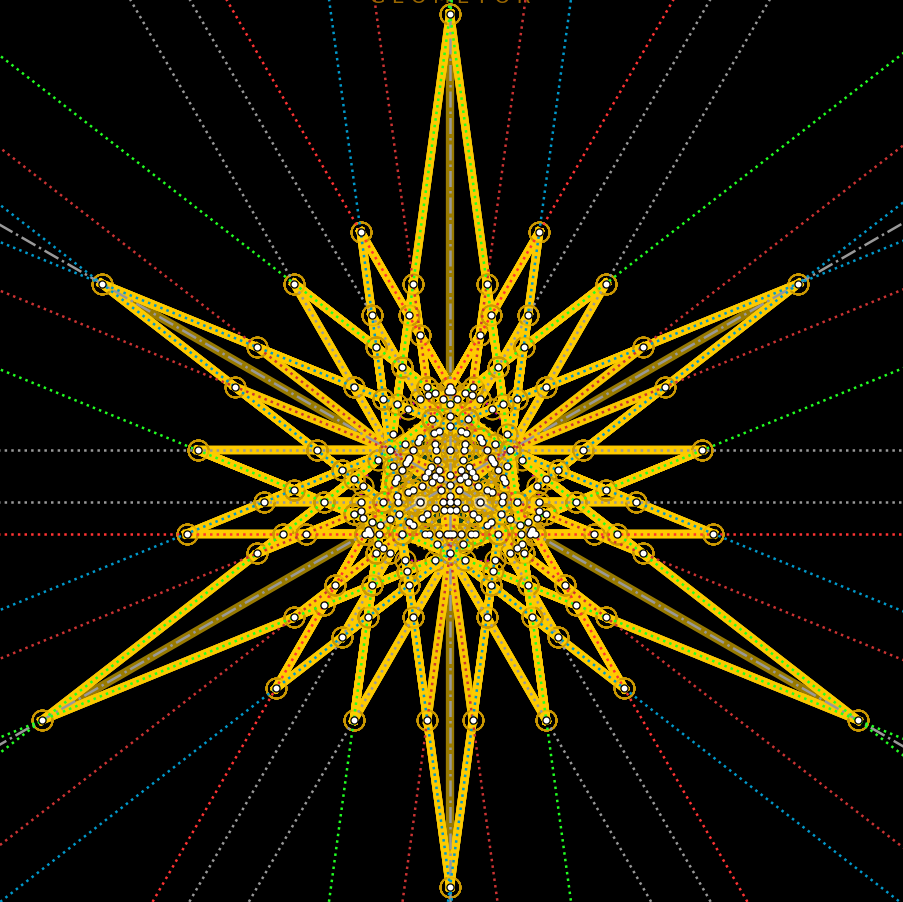
X3513
1st DILATION CENTER
X3513 (1st DILATION CENTER) constructed on acute reference triangle \((a, b, c) = (5, 6, 7)\) with unit baseline AB = \(1\).
Constructed Elements
Central Lines: {3514, 3660}
Related Centers: X3514 (INVERSE-IN-CIRCUMCIRCLE OF X3513), X3660 (MIDPOINT OF {X3513, X3514})
Alternate Coordinates2 forms
Tripolars: \(\tan A' : :\), where JaJbJc is the excentral triangle
Tripolars: \(b + c - a : :\)
Functional Relations5 relations
Notes
David Eppstein, The dilation center of a triangle
for a discussion of X3513 as a point of intersection of three similar ellipses, each having two of the points A, B, C as foci. (Contributed by David Eppstein, 7/10/08)
X3513 is the point P such that the incenter of the circumcevian triangle of P is also the incenter of triangle ABC. (Randy Hutson, 9/23/2011)
X3513 and X3514 are the limiting points (point-circles) of the coaxal system that includes the circumcircle and incircle. Their midpoint, X3660, is the radical trace of the incircle and circumcircle. (Peter Moses, November 15, 2011)
In the plane of a triangle ABC, let P be a point on the line X1X3, and let DEF = intouch triangle. Let \(R_{A}\) = reflection of AP in EF, and define \(R_{B}\) and \(R_{C}\) cyclically. The lines \(R_{A}\), \(R_{B}\), \(R_{C}\) concur in a point, P', that lies on a rectangular hyperbola that circumscribes DEF. Let P″ = DEF-isogonal conjugate of P'. The mapping P → P″ is a projective transformation of the line X1X3, and its fixed points are X3513 and X3514. (Angel Montesdeoca, April 17, 2021)