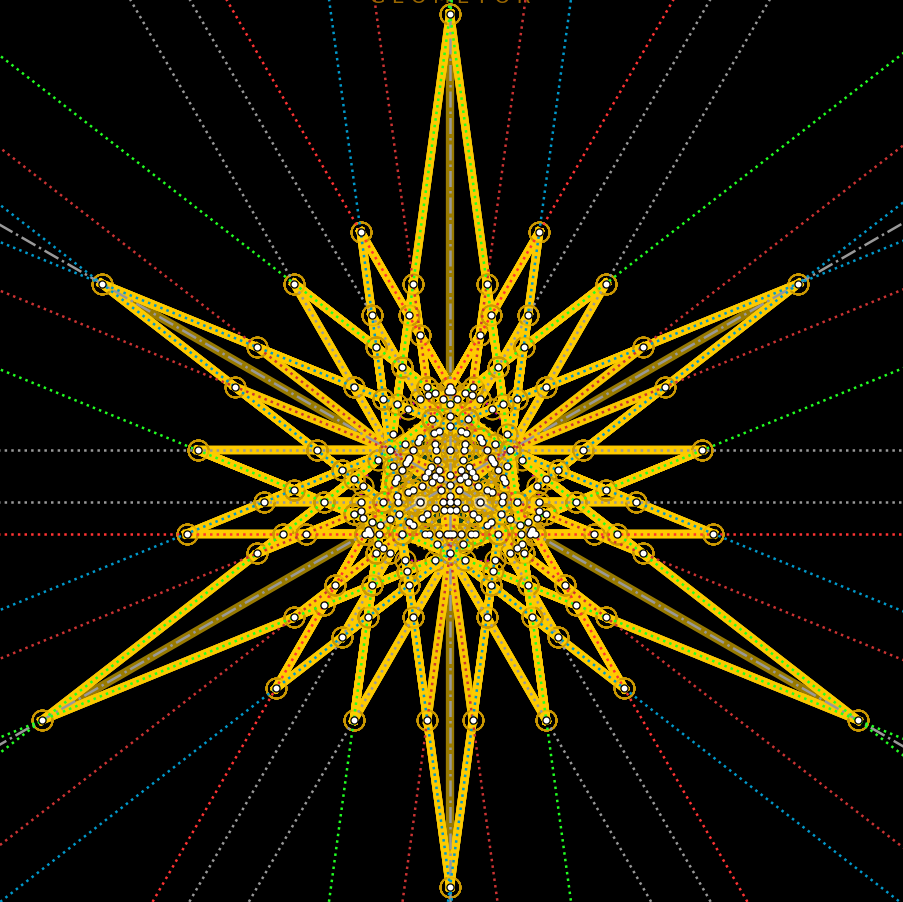
X2855–X2882
Simson-Moses SM(P, U) Points & Conjugates
X2855–X2882 (Simson-Moses SM(P, U) Points & Conjugates) — 15 representative centers (from 28 in collection) constructed on acute reference triangle \((a, b, c) = (5, 6, 7)\) with unit baseline AB = \(1\).
Group Preamble — SM Points (Simson-Moses points)
Centers X2855 to X2868 are examples of Simson-Moses points, defined by changing “isogonal” to “isotomic” in the definition of Simson-Ribgy points (X2687 to X2770. That is, for points P and U on the circumcircle of triangle ABC, the point of intersection of the lines (P and isotomic conjugate of U) and (U and isotomic conjugate of P) defines the Simson-Moses point of P and U, denoted by SM(P,U). If P and U are given in barycentric coordinates \(p : q : r\) and \(u : v : w\), then
(rv - qw)/(qv - rw) : (pw - ru)/(rw - pu) : (qu - pv)/(pu - qv) (barycentrics)
If P and U are given in trilinear coordinates \(p : q : r\) and \(u : v : w\), then
\(b^{2}\)\(c^{2}(rv - qw)\)/(\(b^{2}\)qv - \(c^{2}\)rw) : \(c^{2}\)\(a^{2}(pw - ru)\)/(\(c^{2}\)rw - \(a^{2}\)pu) : \(a^{2}\)\(b^{2}(qu - pv)\)/(\(a^{2}\)pu - \(b^{2}\)qv) (trilinears)
On Oct. 23, 2004, Peter Moses described the point for which the designation SM(P,U) is here introduced, and he noted that SM(P,U), like SR(P,U), lies on the circumcircle.
In the following list, the appearance of I, J, K means that RS(Xi,Xj) = X(K):
The definitions of SR and SM points depend on two kinds of isoconjugates (i.e., isogonal and isotomic). To generalize, suppose
X =\(x : y : z\), P =\(p : q : r\), U =\(u : v : w\)
are points, none on a sideline of triangle ABC. Then
(X-isoconjugate of P) =\(yzqr : zxrp : xypq\) and (X-isoconjugate of U) =\(yzvw : zxwu : xyuv\),
Denote these points by P(X) and U(X), respectively. It is easy to show using determinants that PU(X) and UP(X) meet in the point. That point defines the X-Simson point of :g:`P <P>` and :g:`U <U*>`, denoted by S(X;P,U):
S(X;P,U) = yz(qw - rv)/(qvy - rwz) : zx(ru - pw)/(rwz - pux) : xy(pv - qu)/(pux - qvy).
Theorem: If P and U are on the circumcircle, then S(X;P,U) is on the circumcircle. A “computer proof” is easy: solve the equations a/p + b/q + c/r = 0 and a/u + b/v + c/w = 0 for r and w, substitute for these in a/r + b/s + c/t, where r, s, t are trilinears for S(X;P,U), and find that a/r + b/s + c/t = 0.

X2855SM(X74, X98)

X2856SM(X98, X100)

X2857SM(X98, X110)

X2858SM(X98, X111)

X2859SM(X100, X112)

X2860SM(X100, X101)

X2861SM(X100, X104)

X2862SM(X100, X105)

X2863SM(X100, X106)

X2864SM(X100, X110)

X2865SM(X104, X105)

X2866SM(X105, X109)

X2867SM(X107, X110)

X2868SM(X110, X111)

X2869ISOGONAL CONJUGATE OF X2855

X2870ISOGONAL CONJUGATE OF X2856

X2871ISOGONAL CONJUGATE OF X2857

X2872ISOGONAL CONJUGATE OF X2858

X2873ISOGONAL CONJUGATE OF X2859

X2874ISOGONAL CONJUGATE OF X2860

X2875ISOGONAL CONJUGATE OF X2861

X2876ISOGONAL CONJUGATE OF X2862

X2877ISOGONAL CONJUGATE OF X2863

X2878ISOGONAL CONJUGATE OF X2864

X2879ISOGONAL CONJUGATE OF X2865

X2880ISOGONAL CONJUGATE OF X2866

X2881ISOGONAL CONJUGATE OF X2867
