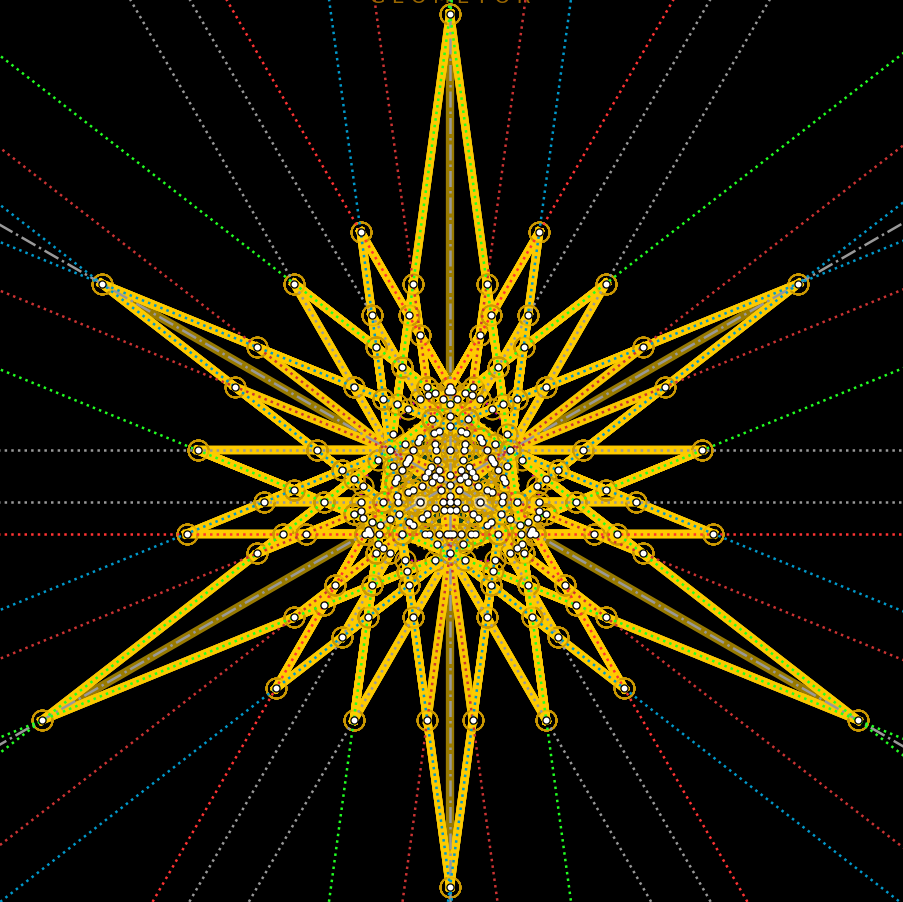
X2677–X2770
Rigby-Simson RS(P, U) & Simson-Rigby SR(P, U) Points
X2677–X2770 (Rigby-Simson RS(P, U) & Simson-Rigby SR(P, U) Points) — 16 representative centers (from 94 in collection) constructed on acute reference triangle \((a, b, c) = (5, 6, 7)\) with unit baseline AB = \(1\).
Group Preamble — RS Points and SR Points (Rigby-Simson points and Simson-Rigby points)
Centers X2677 to X2770 are examples of Rigby-Simson points and Simson-Rigby points. These two types of points are discussed in
Ross Honsberger , Episodes in Nineteenth and Twentieth Century Euclidean Geometry , Mathematical Association of America, 1995. Chapter 11: The Orthopole, pages 124-136.
Specifically, on pages 132-136, Honsberger defines the “Rigby Point,” in honor of John Rigby, as the orthopole of the six sides of two triangles, all of whose vertices lie on a circle, and he notes that this orthopole lies on the six Simson lines of the vertices.
Now suppose that P =\(p : q : r\) (trilinears) and U =\(u : v : w\) are distinct points on the circumcircle of a triangle ABC. Their Simson lines meet in a point X which is here called the Rigby-Simson point of P and U, denoted by RS(P,U). That is, RS(P,U) is the orthopole of line PU with respect to triangle ABC.
On the circumcircle, there is a unique point K whose Simson line is perpendicular to line PU, and whose Simson line also passes through RS(P,U). The point K is here called the Simson-Rigby point of P and U, denoted by SR(P,U). Note that SR(P,U) = Λ(P,U)
If you have The Geometer’s Sketchpad, you can view RS(P,U) and SR(P,U) (RigbySimson.gsp).
Continuing with contributions of Peter Moses during October, 2004, trilinears for RS(P,U) are
\(f(a,b,c,p,q,r,u,v,w) : f(b,c,a,q,r,p,v,w,u) : f(c,a,b,r,p,q,w,u,v)\), where
\(f(a,b,c,p,q,r,u,v,w) = 1/[a^{2}r^{2}v^{2}(q \cos A - p \cos B)(w \cos A - u \cos C)] - 1/[a^{2}q^{2}w^{2}(r \cos A - p \cos C)(v \cos A - u \cos B)]\),
and trilinears for SR(P,U), reckoned as the point of intersection of lines P-to-\(U ^{- 1}\) and U-to-\(P ^{- 1}\), are
(rv - qw)/(qv - rw) : (pw - ru)/(rw - pu) : (qu - pv)/(pu - qv).
In the following list, the appearance of I, J, K means that RS(Xi,Xj) = X(K):
In the next list (from P. Moses, Oct. 15, 2004), the appearance of I, J, K means that SR(Xi,Xj) = X(K):


X2678RS(X74, X101)

X2679RS(X98, X99)

X2680RS(X98, X100)

X2681RS(X98, X101)

X2682RS(X98, X110)

X2683RS(X99, X100)

X2684RS(X99, X101)

X2685RS(X101, X110)


X2687SR(X74, X100)

X2688SR(X74, X101)

X2689SR(X74, X102)

X2690SR(X74, X103)

X2691SR(X74, X105)

X2692SR(X74, X106)

X2693SR(X74, X107)

X2694SR(X74, X108)

X2695SR(X74, X109)

X2696SR(X74, X111)

X2697SR(X74, X112)

X2698SR(X98, X99)

X2699SR(X98, X100)

X2700SR(X98, X101)

X2701SR(X98, X102)

X2702SR(X98, X103)

X2703SR(X98, X104)

X2704SR(X98, X105)

X2705SR(X98, X106)

X2706SR(X98, X107)

X2707SR(X98, X108)

X2708SR(X98, X109)

X2709SR(X98, X111)

X2710SR(X98, X112)

X2711SR(X99, X105)

X2712SR(X99, X106)

X2713SR(X99, X107)

X2714SR(X99, X108)

X2715SR(X99, X112)

X2716SR(X100, X102)

X2717SR(X100, X103)

X2718SR(X100, X106)

X2719SR(X100, X107)

X2720SR(X100, X108)

X2721SR(X100, X111)

X2722SR(X100, X112)

X2723SR(X101, X102)

X2724SR(X101, X103)

X2725SR(X101, X105)

X2726SR(X101, X106)

X2727SR(X101, X107)

X2728SR(X101, X108)

X2729SR(X101, X111)

X2730SR(X102, X105)

X2731SR(X102, X106)

X2732SR(X102, X107)

X2733SR(X102, X108)

X2734SR(X102, X109)

X2735SR(X102, X111)

X2736SR(X103, X105)

X2737SR(X103, X106)

X2738SR(X103, X107)

X2739SR(X103, X108)

X2740SR(X103, X111)

X2741SR(X103, X112)

X2742SR(X104, X105)

X2743SR(X104, X106)

X2744SR(X104, X107)

X2745SR(X104, X108)

X2746SR(X104, X111)

X2747SR(X104, X112)

X2748SR(X105, X106)

X2749SR(X105, X107)

X2750SR(X105, X108)

X2751SR(X105, X109)

X2752SR(X105, X110)

X2753SR(X105, X111)

X2754SR(X105, X112)

X2755SR(X106, X107)

X2756SR(X106, X108)

X2757SR(X106, X109)

X2758SR(X106, X110)

X2759SR(X106, X111)

X2760SR(X106, X112)

X2761SR(X107, X108)

X2762SR(X107, X109)

X2763SR(X107, X111)

X2764SR(X107, X112)

X2765SR(X108, X109)

X2766SR(X108, X110)

X2767SR(X108, X111)

X2768SR(X109, X111)

X2769SR(X109, X112)
