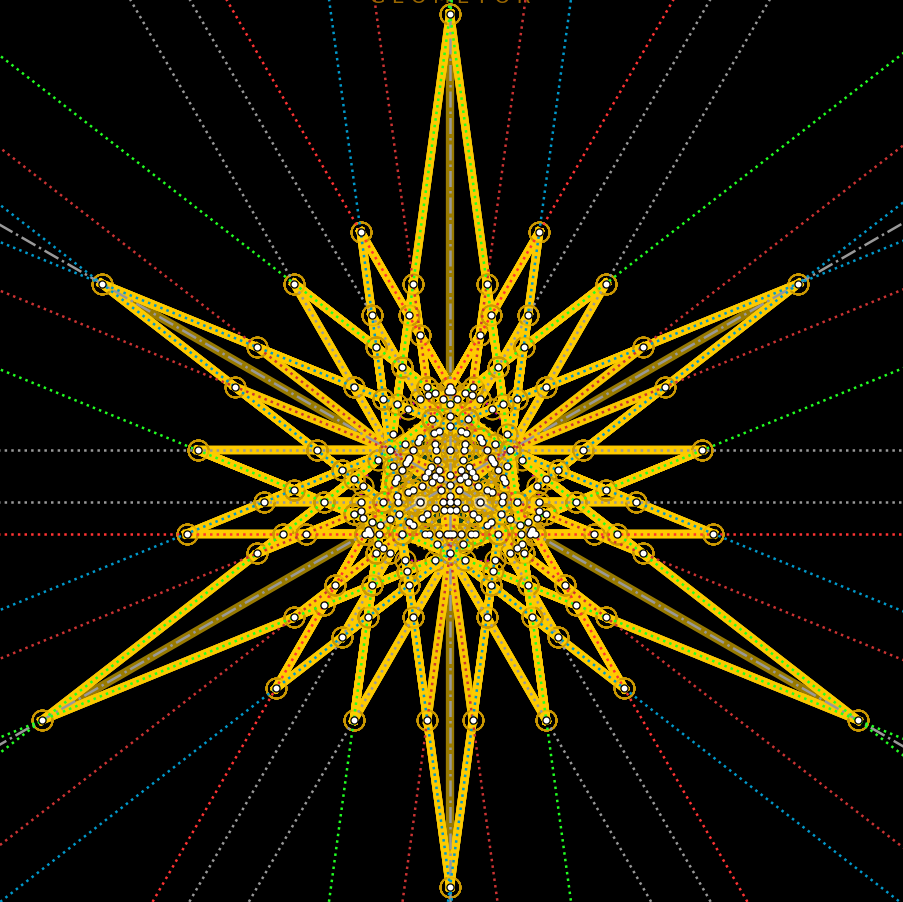
X2365–X2445
Circumcircle CIR(X) Points & Gibert-Simson Transforms
X2365–X2445 (Circumcircle CIR(X) Points & Gibert-Simson Transforms) — 16 representative centers (from 81 in collection) constructed on acute reference triangle \((a, b, c) = (5, 6, 7)\) with unit baseline AB = \(1\).
Group Preamble — More Points on the Circumcircle, 2365-2384
Suppose that U =\(u : v : w\) (trilinears) is a triangle center other than X6, and let CIR(U) be the point given by trilinears
\(F(u,v,w) : F(v,w,u) : F(w,u,v)\) = avw/(\(av^{2}\) + \(aw^{2}\) - buv - cuw) : bwu/(\(bw^{2}\) + \(bu^{2}\) - cvw - avu) : cuv/(\(cu^{2}\) + \(cv^{2}\) - awu - bwv)
CIR(U) lies on the circumcircle. Pairs (i,j) such that Xj = CIR(Xi) include the following:
(1,106), (2,729), (3,1300), (4,1294), (9,1477), (31,767), (37,741), (41,767), (43,106), (44,106), (74,1294), (75,701), (110,99), (125,827), (194,729), (238,741), (265,1300), (1084,689), (1154,1141), (1279,(1477), (1499,1296), (1503,1297), (1510,930), (1634,689)
This section was added to ETC on 10/20/03; the preamble was revised on January 20, 2015, following suggestions by Viktor Kitaysky. Points with trilinears similar to those of CIR(U), called circum-eigentransforms, denoted by CET(U), are given in Section 4.
Group Preamble — GIBERT-SIMSON TRANSFORMS, X2394 -X2419
On October 19, 2003, Bernard Gibert contributed points that lie on the Simson cubic. Indeed, this cubic is the image of the circumcircle under a mapping here named the Gibert-Simson transform. If U =\(u : v : w\) (barycentrics) and U is not X3, then the transform is given by
GS(U) = (\(b^{2}\)\(S_{B}\)/v - \(c^{2}\)\(S_{C}\)/w)u/\(a^{2}\) : (\(c^{2}\)\(S_{C}\)/w - \(a^{2}\)\(S_{A}\)/u)v/\(b^{2}\) : (\(a^{2}\)\(S_{A}\)/u - \(b^{2}\)\(S_{B}\)/v)w/\(c^{2}\).
In case U lies on the circumcircle, these barycentrics are proportional to the respective directed distances from A, B, C, to the Simson line of U. If U* is the antipode of U, then GS(U*) is the isotomic conjugate of GS(U). In the Catalogue at Cubics in the Triangle Plane, the Simson cubic is discussed as K010, and its isogonal transform is the cubic K162. The isogonal conjugates of centers X2365-X2419 are indexed as X2420-X2445.
If U =\(u : v : w\) =\(u(a,b,c) : u(b,c,a) : u(c,a,b)\) (trilinears), then
(cos A)\(x(b^{2}\)\(y^{2}\) + \(c^{2}\)\(z^{2})\) + (cos B)\(y(c^{2}\)\(z^{2}\) + \(a^{2}\)\(x^{2})\) + (cos C)\(z(a^{2}\)\(x^{2}\) + \(b^{2}\)\(x^{2})\) - (\(a^{2}\) + \(b^{2}\) + \(c^{2})\)xyz = 0,
and the cubic K162 by
(cos A)\(x(c^{2}\)\(y^{2}\) + \(b^{2}\)\(z^{2})\) + (cos B)\(y(a^{2}\)\(z^{2}\) + \(c^{2}\)\(x^{2})\) + (cos C)\(z(b^{2}\)\(x^{2}\) + \(a^{2}\)\(x^{2})\) - (\(a^{2}\) + \(b^{2}\) + \(c^{2})\)xyz = 0,
In the definition of eigentransform before X2120, if cevian triangle is replaced by circumcevian triangle, the result is CET(U) as discussed before X2365. Gibert observed that if cevian triangle is replaced by pedal triangle, for U on the circumcircle, the result is the isogonal conjugate of GS(U). That is, [GS(U)] -1 is the eigencenter of the pedal triangle of U (which is a degenerate triangle lying in the Simson line of U).
Regarding triangle centers that do not lie on the circumcircle, GS(Xi) = Xj for these (i,j): (32,669), (48,1459), (187,1649), (248,879), (485,850), (486,850).
This section was added to ETC on 10/23/03. For more Gibert-Simson transforms, see X15411-X15423

X2365CIR(X19)

X2366CIR(X25)

X2367CIR(X32)

X2368CIR(X42)

X2369CIR(X55)

X2370CIR(X56)

X2371CIR(X57)

X2372CIR(X58)

X2373CIR(X67)

X2374CIR(X69)

X2375CIR(X81)

X2376CIR(X219)
X2376 lies on the circumcircle.

X2377CIR(X220)
X2377 lies on the circumcircle.

X2378CIR(X530)

X2379CIR(X531)

X2380CIR(X532)

X2381CIR(X533)

X2382CIR(X537)

X2383CIR(X539)

X2384CIR(X545)

X2385ISOGONAL CONJUGATE OF X2365

X2386ISOGONAL CONJUGATE OF X2366

X2387ISOGONAL CONJUGATE OF X2367

X2388ISOGONAL CONJUGATE OF X2368

X2389ISOGONAL CONJUGATE OF X2369

X2390ISOGONAL CONJUGATE OF X2370

X2391ISOGONAL CONJUGATE OF X2371

X2392ISOGONAL CONJUGATE OF X2372

X2393ISOGONAL CONJUGATE OF X2373

X2394GIBERT-SIMSON TRANSFORM OF X74

X2395GIBERT-SIMSON TRANSFORM OF X98

X2396GIBERT-SIMSON TRANSFORM OF X99

X2397GIBERT-SIMSON TRANSFORM OF X100

X2398GIBERT-SIMSON TRANSFORM OF X101

X2399GIBERT-SIMSON TRANSFORM OF X102

X2400GIBERT-SIMSON TRANSFORM OF X103

X2401GIBERT-SIMSON TRANSFORM OF X104

X2402GIBERT-SIMSON TRANSFORM OF X105

X2403GIBERT-SIMSON TRANSFORM OF X106

X2404GIBERT-SIMSON TRANSFORM OF X107

X2405GIBERT-SIMSON TRANSFORM OF X108

X2406GIBERT-SIMSON TRANSFORM OF X109

X2407GIBERT-SIMSON TRANSFORM OF X110

X2408GIBERT-SIMSON TRANSFORM OF X111

X2409GIBERT-SIMSON TRANSFORM OF X112

X2410GIBERT-SIMSON TRANSFORM OF X476

X2411GIBERT-SIMSON TRANSFORM OF X477

X2412GIBERT-SIMSON TRANSFORM OF X675

X2413GIBERT-SIMSON TRANSFORM OF X1141

X2414GIBERT-SIMSON TRANSFORM OF X1292

X2415GIBERT-SIMSON TRANSFORM OF X1293

X2416GIBERT-SIMSON TRANSFORM OF X1294

X2417GIBERT-SIMSON TRANSFORM OF X1295

X2418GIBERT-SIMSON TRANSFORM OF X1296

X2419GIBERT-SIMSON TRANSFORM OF X1297

X2420ISOGONAL CONJUGATE OF X2394

X2421ISOGONAL CONJUGATE OF X2395

X2422ISOGONAL CONJUGATE OF X2396

X2423ISOGONAL CONJUGATE OF X2397

X2424ISOGONAL CONJUGATE OF X2398

X2425ISOGONAL CONJUGATE OF X2399

X2426ISOGONAL CONJUGATE OF X2400

X2427ISOGONAL CONJUGATE OF X2401

X2428ISOGONAL CONJUGATE OF X2402

X2429ISOGONAL CONJUGATE OF X2403

X2430ISOGONAL CONJUGATE OF X2404

X2431ISOGONAL CONJUGATE OF X2405

X2432ISOGONAL CONJUGATE OF X2406

X2433ISOGONAL CONJUGATE OF X2407

X2434ISOGONAL CONJUGATE OF X2408

X2435ISOGONAL CONJUGATE OF X2409

X2436ISOGONAL CONJUGATE OF X2410

X2437ISOGONAL CONJUGATE OF X2411

X2438ISOGONAL CONJUGATE OF X2412

X2439ISOGONAL CONJUGATE OF X2413

X2440ISOGONAL CONJUGATE OF X2414

X2441ISOGONAL CONJUGATE OF X2415

X2442ISOGONAL CONJUGATE OF X2416

X2443ISOGONAL CONJUGATE OF X2417

X2444ISOGONAL CONJUGATE OF X2418
