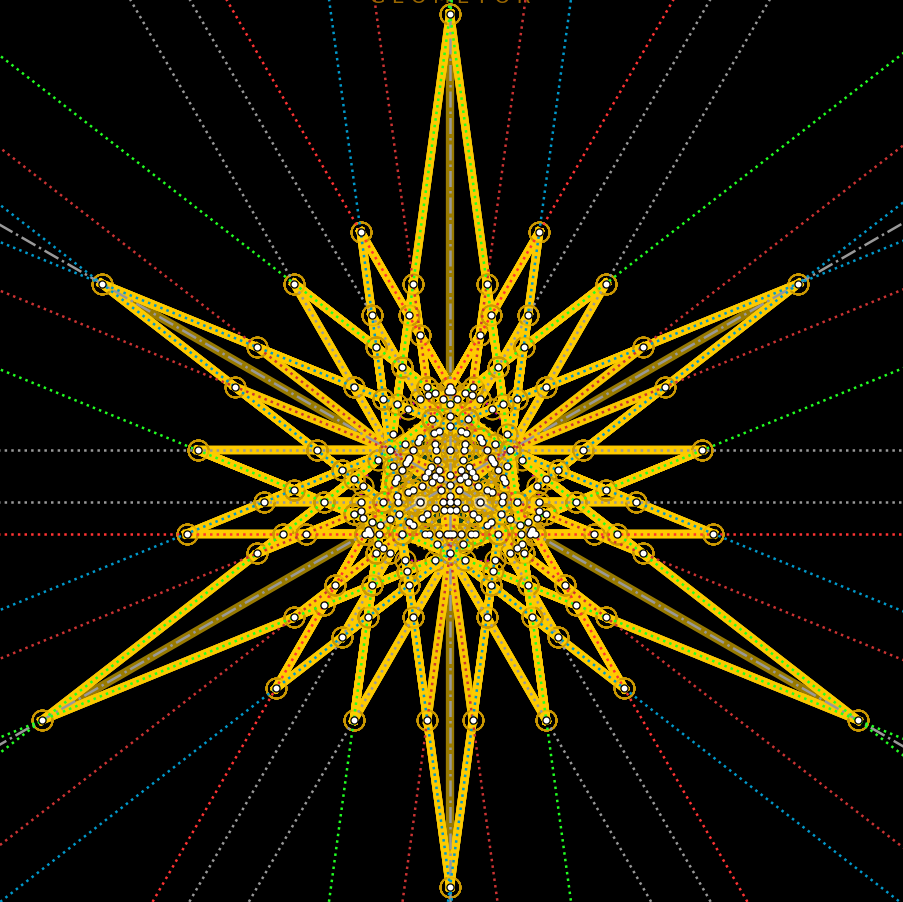
X2120–X2147
Eigencenters & Eigentransforms
X2120–X2147 (Eigencenters & Eigentransforms) — 16 representative centers (from 28 in collection) constructed on acute reference triangle \((a, b, c) = (5, 6, 7)\) with unit baseline AB = \(1\).
Group Preamble — Eigencenters I, 2120 -2143 (Eigencenters and eigentransforms)
The eigencenter of a triangle is defined in the Glossary and in TCCT, p. 192. In case the triangle is the cevian triangle of a point U =\(u : v : w\), the eigencenter is given by
\(f(u,v,w) : f(v,w,u) : f(w,u,v)\), where \(f(u,v,w) = vw(u^{2}v^{2} + u^{2}w^{2} - v^{2}w^{2})\).
This point is now named the eigentransform of U, denoted by ET(U). Pairs (i,j) such that Xj = ET(Xi) include
(1,1), (2,3), (3,1075), (4,155), (6,194), (7,218), (13,62), (14,61), (63,1712), (88,1), (92,47), (94,49), (99,39), (100,1), (110,5), (162,1), (174,266), (190,1), (648,185), (651,1), (653,1), (655,1), (658,1), (660,1), (662,1), (664,2082), (673,1), (694,384), (771,1), (799,1), (811,2083), (823,1), (897,1), (1113,3), (1114,3), (1156,1), (1492,1), (1821,1), (1942,1941)
For any point P not on a sideline of triangle ABC, let \(P ^{-1}\) denote the isogonal conjugate of P. Easily verified properties of eigentransforms include the following.
1. ET(U) = U-Ceva conjugate of \(U ^{-1}\).
2. ET(U) = X1 if and only if U = X1 or U lies on the Steiner circumellipse: yz + zx + xy = 0.
3. ET(U) = eigencenter of the anticevian triangle of \(U ^{-1}\).
4. ET(U) is on the self-isogonal cubic Z(U). That is, if \(x : y : z\) denotes a trilinear variable point, then ET(U) is on the cubic
\(ux(y^{2}\) - \(z^{2})\) + \(vy(z^{2}\) - \(x^{2})\) + \(wz(x^{2}\) - \(y^{2})\) = 0.
5. The U-Ceva conjugate of every X on Z(U) is on Z(U); thus, the U-Ceva conjugate, V, of X1, lies on Z(U); trilinears for \(V ^{-1}\) are
1/(1/v + 1/w - 1/u) : 1/(1/w + 1/u - 1/v) : 1/(1/u + 1/v - 1/w);
ET(U) is the third point of intersection of the line X1-to-\(V ^{-1}\) and the cubic Z(U).
6. As U is the pivot of Z(U), the following points on Z(U) are collinear: U, ET(U), [ET(U)] -1 .
For discussions and generalizations using barycentric coordinates, see Section 1.4 of “Special Isocubics in the Triangle Plane,” downloadable from Bernard Gibert’s Cubics in the Triangle Plane. The cubic Z(U) is there denoted by pK(X6,U), and ET(U) is = (cevian quotient of U and \(U^{*})\) = (U-Ceva conjugate of \(U ^{-1})\); ET(U) is the tangential of \(U^{*}\) in pK(X6,U).
This section was added to ETC on 10/(14-17)/03.

X2120EIGENTRANSFORM OF X5

X2121ISOGONAL CONJUGATE OF X2120

X2122EIGENTRANSFORM OF X8

X2123ISOGONAL CONJUGATE OF X2122

X2124EIGENTRANSFORM OF X9

X2125ISOGONAL CONJUGATE OF X2124

X2126EIGENTRANSFORM OF X10

X2127ISOGONAL CONJUGATE OF X2126

X2128EIGENTRANSFORM OF X19

X2129ISOGONAL CONJUGATE OF X2128

X2130EIGENTRANSFORM OF X20

X2131ISOGONAL CONJUGATE OF X2130

X2132EIGENTRANSFORM OF X30

X2133ISOGONAL CONJUGATE OF X2132

X2134EIGENTRANSFORM OF X37

X2135ISOGONAL CONJUGATE OF X2134

X2136EIGENTRANSFORM OF X57

X2137ISOGONAL CONJUGATE OF X2136

X2138EIGENTRANSFORM OF X69

X2139ISOGONAL CONJUGATE OF X2138

X2140EIGENTRANSFORM OF X101

X2141ISOGONAL CONJUGATE OF X2140

X2142EIGENTRANSFORM OF X512

X2143ISOGONAL CONJUGATE OF X2142

X2144-EIGENTRANSFORM OF X238

X2145-ISOCONJUGATE OF X2144

X2146-CEVA CONJUGATE OF X365
