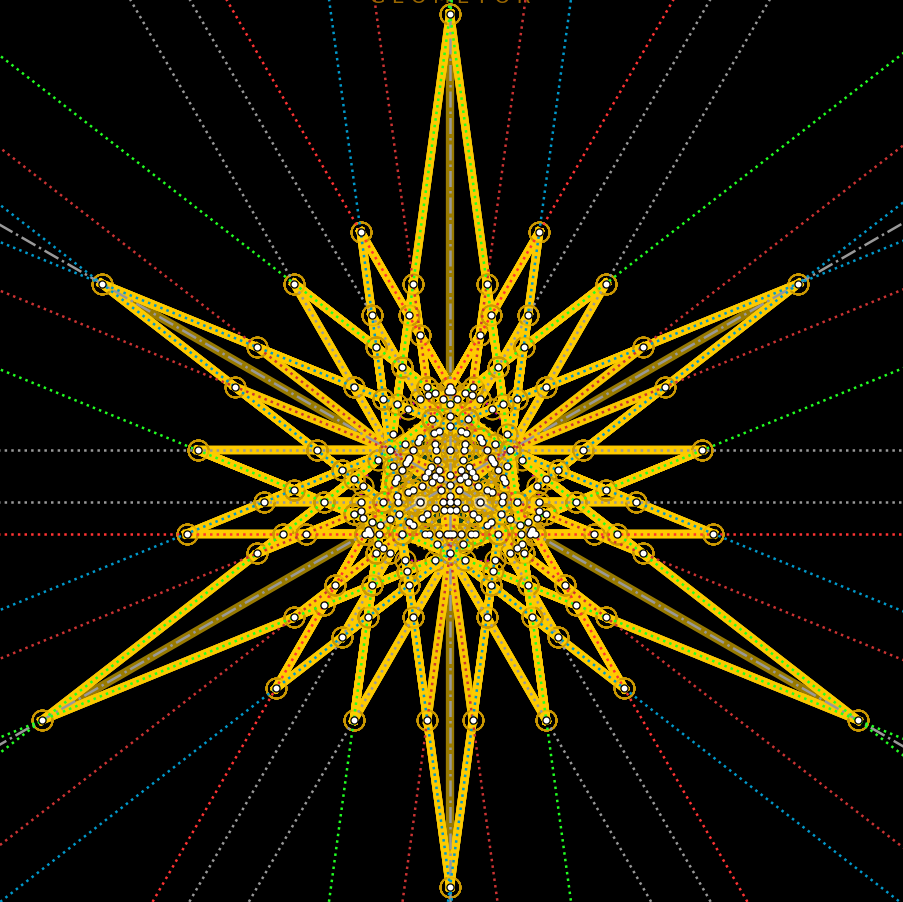
X1707–X1788
Mimosa Transforms
X1707–X1788 (Mimosa Transforms) — 16 representative centers (from 82 in collection) constructed on acute reference triangle \((a, b, c) = (5, 6, 7)\) with unit baseline AB = \(1\).
Group Preamble — Mimosa Transforms 1707-1788 (Mimosa transforms and inverse Mimosa tranforms)
The Mimosa transform M(X) of a point X =\(x : y : z\) is defined (9/15/03) by
M(X) = - yz cos A + zx cos B + xy cos C : - zx cos B + xy cos C + yz cos A : - xy cos C + yz cos A + xy cos C
and the inverse Mimosa transform \(M ^{-1}(X)\), by
\(M ^{-1}(X)\) = (cos A)/(y + z) : (cos B)/(z + x) : (cos C)/(x + y).
As with other names in ETC, the name Mimosa is that of a star. M(X) is the X*X4-Ceva conjugate of X1, where * denotes trilinear product, and \(M ^{-1}(X)\) is the trilinear quotient X3/P(X), where P(X) is the crosssum of X1 and X.
Let g(P,X) denote the P-gimel conjugate of X. The Mimosa transform M(X) arises in connection with the equation \(g(P,X) = X\). Referring to the definition of gimel conjugate in the Glossary, if
P =\(p : q : r\) and X =\(x : y : z\)
are triangle centers, then the equation \(g(P,X) = X is equivalent to the ratio-equation\)
(2absvS - 8yσ2)/(2abswS - 8zσ2) = y/z,
where v = (cos A)/p - (cos B)/q + (cos C)/r and w = (cos A)/p + (cos B)/q - (cos C)/r.
If S = 0, then the ratio-equation holds. As S = x(bq + cr) + y(cr + ap) + z(ap + bq), it follows that if P is given, then \(g(P,X) = X if X is on the line S\)= 0 (regarding \(x : y : z\) as variable); and that if X is given, then \(g(P,X) = P if P is on the line S\)= 0 (regarding \(p : q : r\) as variable). There are too many such cases of gimel conjugates for all to be itemized in ETC. For example, if X = X1, then \(g(P,X) = X\) for every P on the line at infinity; if X = X513, then \(g(P,X) = X\) for every P on the line X1X2; and if X = X656, then \(g(P,X) = X\) for every P on the Euler line, X2X3.
If S ≠ 0, the ratio-equation lends itself to easy simplifications and two Tables conclusions: (1) if P is given then X = M(P) is a solution of \(g(P,X) = X\), and (2) if X is given then P = M*(X) is a solution of \(g(P,X) = X\).
Of course, reversing the pairs gives a list of (J,I) for which Xi = M*(Xj).

X1707MIMOSA TRANSFORM OF X6

X1708MIMOSA TRANSFORM OF X7

X1709MIMOSA TRANSFORM OF X9


X1711MIMOSA TRANSFORM OF X19

X1712MIMOSA TRANSFORM OF (20)

X1713MIMOSA TRANSFORM OF X27


X1715MIMOSA TRANSFORM OF X29

X1716MIMOSA TRANSFORM OF X31

X1717MIMOSA TRANSFORM OF X35


X1719MIMOSA TRANSFORM OF X37

X1720MIMOSA TRANSFORM OF X40

X1721MIMOSA TRANSFORM OF X55

X1722MIMOSA TRANSFORM OF X56

X1723MIMOSA TRANSFORM OF X57

X1724MIMOSA TRANSFORM OF X58

X1725MIMOSA TRANSFORM OF X74

X1726MIMOSA TRANSFORM OF X75

X1727MIMOSA TRANSFORM OF X80

X1728MIMOSA TRANSFORM OF X84

X1729MIMOSA TRANSFORM OF X85

X1730MIMOSA TRANSFORM OF X86

X1731MIMOSA TRANSFORM OF X88

X1732MIMOSA TRANSFORM OF X89

X1733MIMOSA TRANSFORM OF X98

X1734MIMOSA TRANSFORM OF X101

X1735MIMOSA TRANSFORM OF X102

X1736MIMOSA TRANSFORM OF X103

X1737MIMOSA TRANSFORM OF X104

X1738MIMOSA TRANSFORM OF X105

X1739MIMOSA TRANSFORM OF X106

X1740MIMOSA TRANSFORM OF X184

X1741MIMOSA TRANSFORM OF X189

X1742MIMOSA TRANSFORM OF X212

X1743MIMOSA TRANSFORM OF X222


X1745MIMOSA TRANSFORM OF X255


X1748MIMOSA TRANSFORM OF X264

X1749MIMOSA TRANSFORM OF X265

X1750MIMOSA TRANSFORM OF X268

X1751MIMOSA TRANSFORM OF X272


X1753MIMOSA TRANSFORM OF X280


X1755MIMOSA TRANSFORM OF X287

X1756MIMOSA TRANSFORM OF X293

X1757MIMOSA TRANSFORM OF X295

X1758MIMOSA TRANSFORM OF X296

X1759MIMOSA TRANSFORM OF X304

X1760MIMOSA TRANSFORM OF X305

X1761MIMOSA TRANSFORM OF X306

X1762MIMOSA TRANSFORM OF X307

X1763MIMOSA TRANSFORM OF X326

X1764MIMOSA TRANSFORM OF X332


X1766MIMOSA TRANSFORM OF X345

X1767MIMOSA TRANSFORM OF X347

X1768MIMOSA TRANSFORM OF X521

X1769MIMOSA TRANSFORM OF X901

X1770MIMOSA TRANSFORM OF X943


X1776MIMOSA TRANSFORM OF X1156


X1778MIMOSA TRANSFORM OF X1171


X1780MIMOSA TRANSFORM OF X1175

X1781MIMOSA TRANSFORM OF X1214


X1783MIMOSA TRANSFORM OF X1262

X1784MIMOSA TRANSFORM OF X1294

X1785MIMOSA TRANSFORM OF X1295


