X1655
2nd HATZIPOLAKIS PARALLELIAN POINT
Continuing from the description of X1654, let h(B,A) be the distance from the point BA to the line CA, and define five other distances cyclically. If P = X1655, then
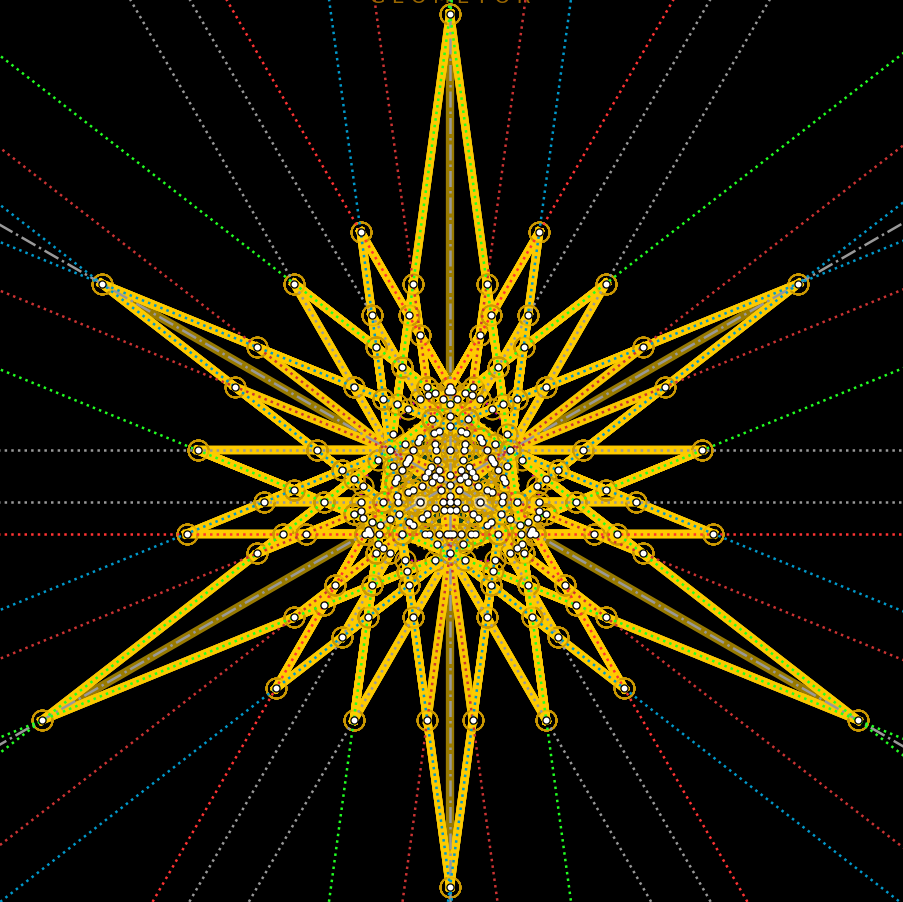
X1655 (2nd HATZIPOLAKIS PARALLELIAN POINT) constructed on acute reference triangle \((a, b, c) = (5, 6, 7)\) with unit baseline AB = \(1\).
Constructed Elements
Derived Triangle: Anticomplementary Triangle △KaKbKc — vertices Ka, Kb, Kc (Formed by lines through A, B, C parallel to opposite sides)
Central Lines: {2, 274}
Related Centers: X2 (CENTROID), X274 (ISOGONAL CONJUGATE OF X213)
Trilinears: \(f(a,b,c) : f(b,c,a) : f(c,a,b)\), where \(f(a,b,c) = bc[-1/a^{2} + 1/b^{2} + 1/c^{2} + 1/(bc) + 1/(ca) + 1/(ab)]\)
Barycentrics: \(g(a,b,c) : g(b,c,a) : g(c,a,b)\), where \(g(a,b,c) = -1/a^{2} + 1/b^{2} + 1/c^{2} + 1/(bc) + 1/(ca) + 1/(ab)\)
Search Value (6, 9, 13): \(1.445819564171\)
Functional Relations4 relations
X1655 = anticomplement of X274
X1655 = isotomic conjugate of isogonal conjugate of X21779
X1655 = polar conjugate of isogonal conjugate of X23079
X1655 = Xi-Ceva conjugate of Xj for these (i,j): (37, 2), (1909, 8)
Notes
h(B,A) + \(h(C,A) = h(C\),B) + \(h(A,B) = h(A\),C) + h(B,C) (Antreas Hatzipolakis, Anopolis #20, 1/20/02)