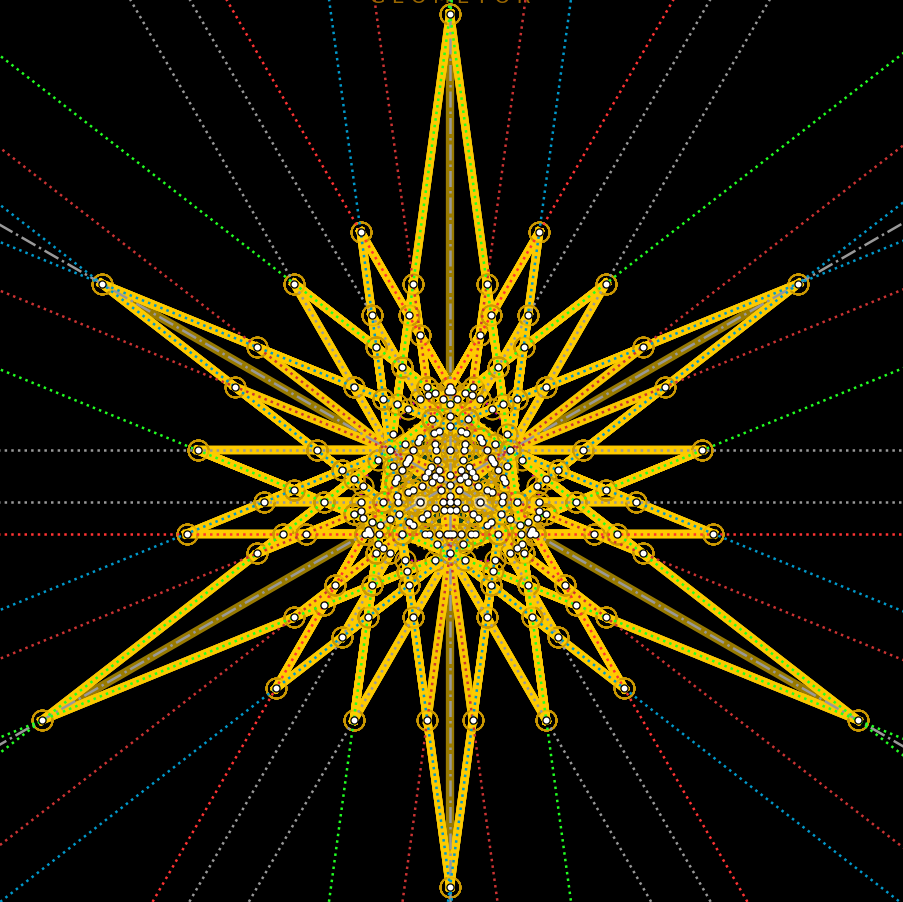
X1286–X1311
Collings Transforms
X1286–X1311 (Collings Transforms) — 14 representative centers (from 26 in collection) constructed on acute reference triangle \((a, b, c) = (5, 6, 7)\) with unit baseline AB = \(1\).
Group Preamble — Collings Transforms: 1286-1311
If ABC is a triangle, P is a point, and A', B', C' are the reflections of A, B, C in P, then the circumcircles of triangles AB'C', A'BC' and A'B'C concur at a point Q on the circumcircle of triangle ABC. The transformation T given by Q = T(P) was described by
S. N. Collings, “Reflections on reflections 2”, Mathematical Gazette 1974, page 264.
It was further discussed by Floor van Lamoen and Darij Grinberg, and coordinates were found by Barry Wolk; see Hyacinthos #4547, #4548, #6469, #6538, #6546, #6560. Paul Yiu noted that T(P) is the point, other than A, B, C, in which the circumconic centered at P meets the circumcircle of triangle ABC (#4548).
If P =\(x : y : z\) (trilinears), then Q =\(f(a,b,c) : f(b,c,a) : f(c,a,b)\), where
\(f(a,b,c) = 1/[bz(ax + by - cz) - cy(ax + cz - by)]\).
For given Q, the set of points P satisfying T(P) = Q is a conic. Examples follow:
Bernard Gibert (4/02/03) identified T(P) as the trilinear pole of the line of X6 and the X2-Ceva conjugate of P. He identified the locus of P as the rectangular hyperbola that circumscribes the medial triangle and has center W given by the vector equation 4X2W = X2Q. The anticomplement of this hyperbola is the rectangular ABC-circumhyperbola whose center is the complement of Q. Thus, referring to examples given above:

X1286COLLINGS TRANSFORM OF X22
X1286 lies on the circumcircle.

X1287COLLINGS TRANSFORM OF X23
X1287 lies on the circumcircle.

X1288COLLINGS TRANSFORM OF X24

X1289COLLINGS TRANSFORM OF X25

X1290COLLINGS TRANSFORM OF X36

X1291COLLINGS TRANSFORM OF X50

X1292COLLINGS TRANSFORM OF X55

X1293COLLINGS TRANSFORM OF X121

X1294COLLINGS TRANSFORM OF X122

X1295COLLINGS TRANSFORM OF X123

X1296COLLINGS TRANSFORM OF X126

X1297COLLINGS TRANSFORM OF X127

X1298COLLINGS TRANSFORM OF X130

X1299COLLINGS TRANSFORM OF X135

X1300COLLINGS TRANSFORM OF X136

X1301COLLINGS TRANSFORM OF X235

X1302COLLINGS TRANSFORM OF X381

X1303COLLINGS TRANSFORM OF X389

X1304COLLINGS TRANSFORM OF X403

X1305COLLINGS TRANSFORM OF X440

X1306COLLINGS TRANSFORM OF X639

X1307COLLINGS TRANSFORM OF X640

X1308COLLINGS TRANSFORM OF X661

X1309COLLINGS TRANSFORM OF X860

X1310COLLINGS TRANSFORM OF X940
