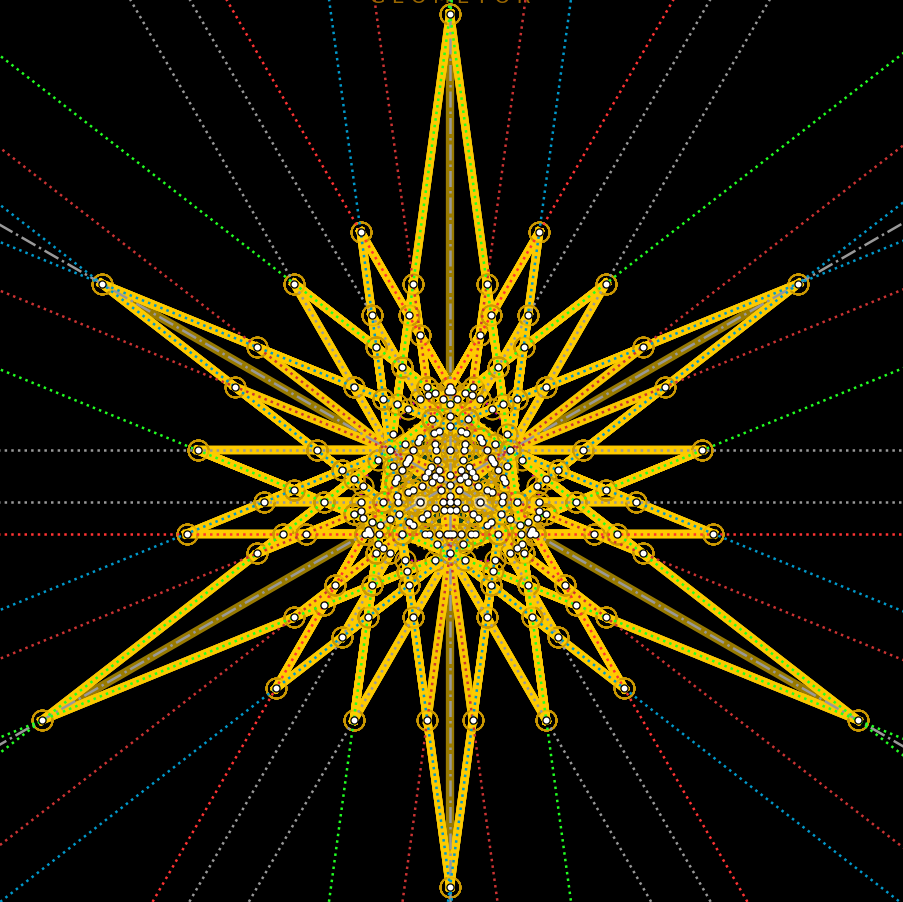
X360
HOFSTADTER ZERO POINT
X360 (HOFSTADTER ZERO POINT) constructed on acute reference triangle \((a, b, c) = (5, 6, 7)\) with unit baseline AB = \(1\).
Constructed Elements
Central Lines: {2, 1115}
Related Centers: X2 (CENTROID), X1115 (EXTERIOR-ANGLE CURVATURE CENTROID)
Linear Combinations1 combination
X360 = \(A\) A + \(B\) B + \(C\) C, where A, B, C are the angles and A, B, C are the vertices
Functional Relations25 relations
X1 = Hofstadter 1/2 point = antigonal image of X80
X4 = Hofstadter -1 point
X35 = Hofstadter 3/2 point
X186 = Hofstadter 3 point = antigonal image of X5962
X357 = Hofstadter 1/3 point
X358 = Hofstadter 2/3 point
X359 = Hofstadter 0 point
X360 = Hofstadter 1 point
X1127 = Hofstadter 1/4 point
X1129 = Hofstadter 3/4 point
X5457 = Hofstadter -1/3 point
X5458 = Hofstadter -2/3 point
X5961 = Hofstadter 4 point = antigonal image of X5964
X5962 = Hofstadter -3 point = antigonal image of X186
X5963 = Hofstadter 5 point
X5964 = Hofstadter -4 point = antigonal image of X5961
X360 = isogonal conjugate of X359
X360 = anticomplement of X1115
X360 = Xi-anticomplementary conjugate of Xj for these (i,j): {7021, 8}, {7041, 69}
X360 = Xi-isoconjugate of Xj for these (i,j): {1, 359}, {6, 1077}
X360 = barycentric quotient Xi/Xj for these {i,j}: {1, 1077}, {6, 359}, {1049, 1}, {1077, 1028}, {1085, 1049}
Notes
This point is obtained as a limit of perspectors. Let r denote a real number, but not 0 or 1. Using vertex B as a pivot, swing line BC toward vertex A through angle rB and swing line BC about C through angle rC. Let A(r) be the point in which the two swung lines meet. Obtain B(r) and C(r) cyclically. Triangle A(r)B(r)C(r) is the r-Hofstadter triangle; its perspector with ABC, called the Hofstadter r point, is the point given by trilinears
(sin rA)/sin(A - rA) : (sin rB)/sin(B - rB) : (sin rC)/sin(C - rC).
Clark Kimberling, “Hofstadter points,” Nieuw Archief voor Wiskunde 12 (1994) 109-114.
If r is an integer other than 0, 1, or 2, then the inverse-in-circumcircle of the Hofstadter r point is the Hofstadter (2-r) point;
thus, since the isogonal conjugate of the Hofstadter r point is the Hofstadter (1-r) point, if r is not -1, 0 or 1,
then the antigonal image of the Hofstadter r point is the Hofstadter -r point.