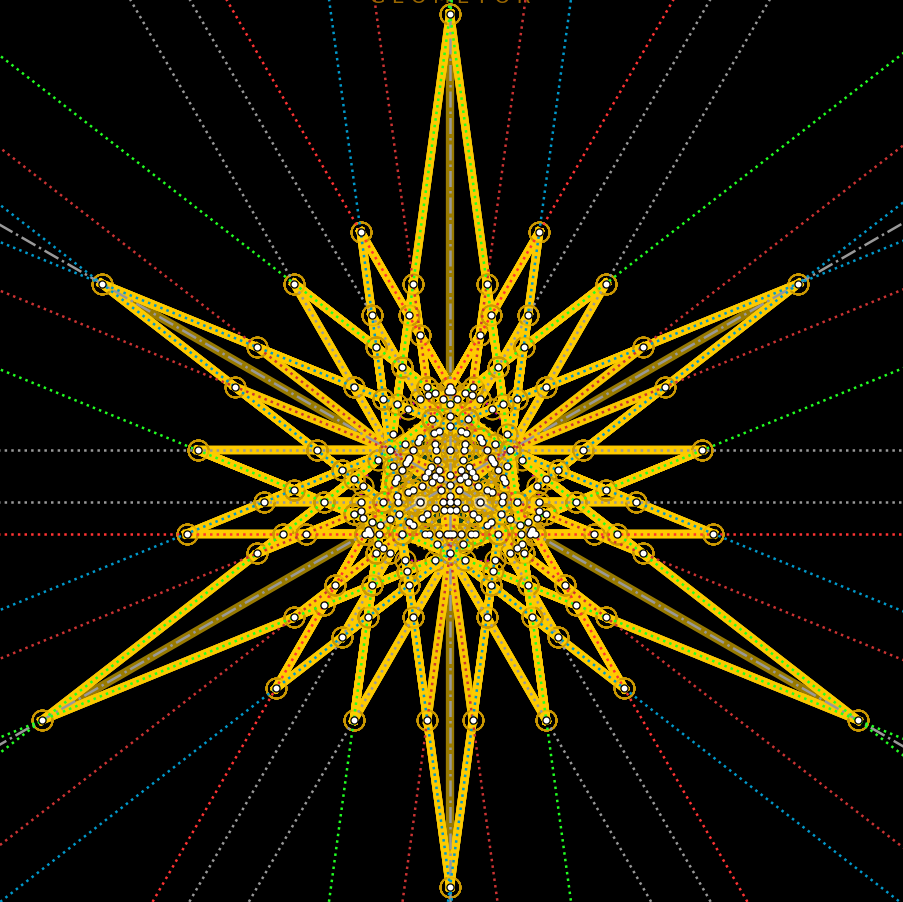
X356
MORLEY CENTER
X356 (MORLEY CENTER) constructed on acute reference triangle \((a, b, c) = (5, 6, 7)\) with unit baseline AB = \(1\).
Constructed Elements
Central Lines: {357, 358}, {1134, 1135}
Related Centers: X3605 (ISOGONAL CONJUGATE OF X356), X357 (1st MORLEY-TAYLOR-MARR CENTER), X358 (2nd MORLEY-TAYLOR-MARR CENTER), X1134 (3rd MORLEY-TAYLOR-MARR CENTER), X1135 (4th MORLEY-TAYLOR-MARR CENTER)
Alternate Coordinates1 form
Trilinears: \(\cos(B/3 - C/3) + \sqrt{3}\sin(A/3 + \pi /3)\) (M. Stevanovic, 12/25/2007)
Functional Relations2 relations
X356 = isogonal conjugate of X3605
X356 = orthology center of 1st Morley adjunct triangle and 1st Morley triangle
Notes
C. O. Oakley and J. C. Baker, “The Morley trisector theorem,” American Mathematical Monthly 85 (1978) 737-745.
For a sketch of the Morley cubic and list of centers on it, including X356, X357, X358, see Bernard Gibert’s site.
Let A'B'C' be the 1st Morley triangle. Let A″ be the cevapoint of B' and C', and define B″ and C″ cyclically. The lines AA″, BB″, CC″ concur in X356. (Randy Hutson, September 14, 2016)
For a biographical sketch, including details about Morley’s famous theorem on angle trisectors, with history and references, see
Frank Morley (1860-1937) geometer (../bstud/morley.html).