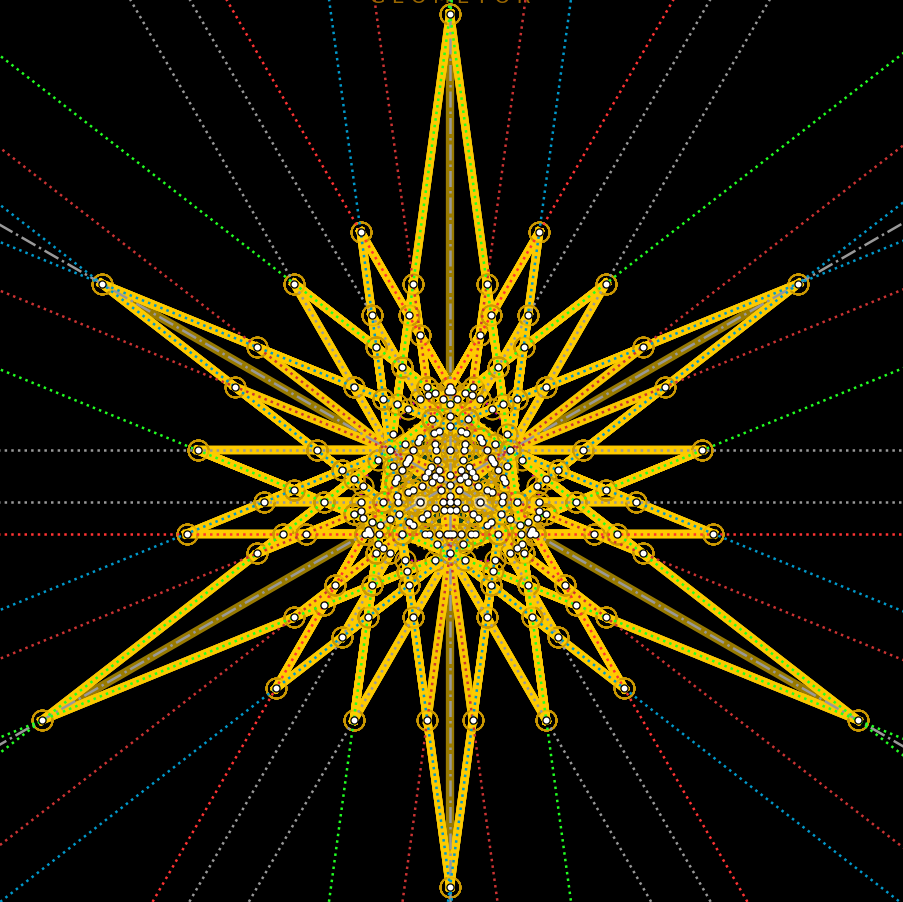
X176
EQUAL DETOUR POINT
X176 (EQUAL DETOUR POINT) constructed on acute reference triangle \((a, b, c) = (5, 6, 7)\) with unit baseline AB = \(1\).
Constructed Elements
Central Lines: {1, 7}, {489, 664}
Related Centers: X1 (INCENTER), X7 (GERGONNE POINT), X489 (CEVAPOINT OF X20 AND X487), X664 (TRILINEAR POLE OF LINE X2X7)
Alternate Coordinates3 forms
Barycentrics: \(2a + (a + b + c) \tan(A/2) : :\)
Barycentrics: \(a + r_{a} : b + r_{b} : c + r_{c}\), where \(r_{a}\), \(r_{b}\), \(r_{c}\) are the exradii
Barycentrics: \((a + b - c) \cdot (a - b + c) \cdot (a (a - b - c) - S) : :\)
X176 lies on K032, K199, K200, K1175, Q074, Q092, Q104.
Incident Central Lines61 lines
{1, 7}, {2, 1659}, {4, 10904}, {8, 1271}, {40, 34494}, {65, 6404}, {69, 10907}, {105, 30386}, {144, 30556}, {174, 1274}, {226, 1132}, {241, 38487}, {280, 40699}, {329, 3083}, {388, 10910}, {489, 664}, {517, 39794}, {651, 1124}, {1086, 44635}, {1123, 10252}, {1463, 7362}, {1587, 8953}, {1588, 8978}, {2082, 6204}, {2550, 45714}, {3062, 10972}, {3084, 9776}, {3177, 31408}, {3296, 34215}, {3297, 6180}, {3298, 5228}, {3622, 8243}, {4000, 7969}, {4644, 7968}, {5045, 39795}, {5222, 18991}, {5226, 5405}, {5261, 9906}, {5393, 5435}, {5932, 31529}, {5933, 31531}, {6283, 20358}, {6360, 37881}, {6405, 49537}, {7586, 30324}, {8973, 23259}, {9778, 10134}, {10405, 14121}, {10580, 16662}, {11294, 17086}, {13386, 20211}, {13388, 21454}, {13437, 16440}, {15913, 31537}, {16213, 32080}, {17365, 44636}, {17950, 43133}, {21453, 30336}, {30346, 31589}, {30412, 31548}, {31545, 32200}
Functional Relations20 relations
X176 = reflection of Xi in Xj for these {i,j}: {20, 8984}, {175, 3160}, {7090, 31535}, {10405, 14121}, {30333, 1}
X176 = isogonal conjugate of X30335
X176 = isotomic conjugate of X40700
X176 = anticomplement of X7090
X176 = anticomplement of the isogonal conjugate of X6502
X176 = Xi-anticomplementary conjugate of Xj for these (i,j): {6, 13387}, {603, 175}, {1806, 3869}, {2066, 329}, {2067, 31551}, {6502, 8}, {13389, 69}, {13390, 21270}, {16232, 4}, {30556, 3436}, {34125, 13386}
X176 = X8-Ceva conjugate of X175
X176 = X10134-cross conjugate of X7
X176 = Xi-isoconjugate of Xj for these (i,j): {1, 30335}, {6, 15892}, {31, 40700}, {56, 34912}
X176 = cevapoint of Xi and Xj for these (i,j): {1, 34494}, {10252, 32057}
X176 = X6291-of-excentral-triangle
X176 = X7362-of-(inner)-tangential-mid-arc-triangle (TCCT 6.15)
X176 = barycentric product Xi*Xj for these {i,j}: {7, 30412}, {8, 16663}, {13390, 31548}
X176 = barycentric quotient Xi/Xj for these {i,j}: {1, 15891}, {2, 40699}, {6, 30336}, {9, 34911}, {9778, 30412}, {16662, 7}, {30413, 8}
X176 = {Xi,Xj}-harmonic conjugate of Xk for these (i,j,k): {1, 7, 175}, {1, 481, 17802}, {1, 482, 7}, {1, 1371, 482}, {1, 1373, 481}, {1, 1374, 31539}, {1, 17804, 21170}, {1, 17806, 31538}, {1, 21170, 17801}, {1, 21171, 31602}, {1, 30341, 11038}, {1, 31538, 17805}, {1, 31567, 8236}, {1, 31601, 21169}, {7, 482, 21169}, {7, 1371, 17804}, {7, 8236, 31565}, {7, 17802, 481}, {7, 17805, 1}, {7, 21169, 21170}, {7, 31601, 482}, {7, 31602, 1374}, {20, 347, 175}, {77, 962, 175}, {175, 482, 21170}, {175, 17804, 21169}, {175, 21169, 7}, {269, 9785, 175}, {279, 390, 175}, {481, 482, 1373}, {481, 1373, 7}, {481, 17802, 175}, {482, 1371, 31601}, {482, 17805, 175}, {482, 17806, 17805}, {482, 31538, 1}, {482, 31539, 21171}, {482, 31601, 17804}, {1323, 30332, 175}, {1371, 17805, 21169}, {1371, 17806, 1}, {1371, 31538, 7}, {1374, 21171, 7}, {1374, 31539, 31602}, {1442, 4295, 175}, {1443, 30305, 175}, {1659, 13389, 2}, {3600, 3672, 175}, {3638, 3639, 1371}, {3663, 4308, 175}, {3664, 4323, 175}, {3668, 4313, 175}, {3674, 4344, 175}, {4296, 4329, 175}, {4297, 36640, 175}, {4318, 17170, 175}, {4862, 6049, 175}, {5542, 5543, 175}, {5731, 22464, 175}, {7090, 31535, 2}, {7190, 11037, 175}, {8236, 10481, 175}, {10134, 32082, 16663}, {10481, 31567, 31565}, {17804, 21169, 482}, {17805, 31601, 7}, {21171, 31539, 1374}, {30424, 31721, 175}, {31538, 31601, 175}, {31539, 31602, 175}
Notes
The points X175 and X176 are discussed in an 1890 article by Emile Lemoine, accessible at Gallica. The article begins on page 111, and the two points are considered beginning on page 128.
The following construction was found by Elkies: call two circles within ABC companion circles if they are the incircles of two triangles formed by dividing ABC into two smaller triangles by passing a line through one of the vertices and some point on the opposite side; chain of circles O(1), O(2), … such that O(n),O(n+1) are companion incircles for every n consists of at most six distinct circles; there is a unique chain consisting of only three distinct circles; and for this chain, the three subdividing lines concur in X176.
G. R. Veldkamp, “The isoperimetric point and the point(s) of equal detour,” American Mathematical Monthly 92 (1985) 546-558.
Noam D. Elkies and Jiro Fukuta, Problem E 3236 and Solution, American Mathematical Monthly 97 (1990) 529-531 [proposed 1987].
Mowaffaq Hajja and Peter Yff, “The isoperimetric point and the point(s) of equal detour in a triangle,” Journal of Geometry 87 (2007) 76-82.
Let Ia, Ib, Ic be the centers of the Elkies companion incircles. Let A' be the trilinear product Ib*Ic, and define B' and C' cyclically. The lines AA', BB', CC' concur in X482. The lines IaA', IbB', IcC' concur in X176. (Randy Hutson, December 2, 2017)
Let Q be a point. Let A' be the incenter of triangle BCQ, and define B' and C' cyclically. If Q is an equal detour point, in the sense that |QB| + |QC| - |BC| = |QC| + |QA| - |CA| = |QA| + |QB| - |AB|, then Q is either the incenter or an excenter of triangle A'B'C'. (Do there exist other points with this property?) (Randy Hutson, 9/23/2011)’’
For the Moses-Gheorghe-Reznick conic, see X175.
In the plane of a triangle ABC, let
Oa = circle with diameter BC
C' = the point, other than B, where Oa meets AB
B' = the point, other than C, where Oa meets AC
Ub = B-mixtilinear incircle of BCC'
Uc = C-mixtilinear incircle of CBC'
Ab = touchpoint of Ub and BC; define Bc and Ca cyclically
Ac = touchpoint of Uc and BC; define Ba and Cb cyclically
The points Ab, Ac, Ba, Ba, Cb, Cb line on a conic, of which the center is X176. A barycentric equation for this conic follows:
2 (a-b-c) (a^2-b^2-c^2) (a^2 (b+c)-(b-c)^2 (b+c)+2 a S) x^2 - ((a+b-c) (a-b+c) (3 a^4-2 a^3 (b+c)-3 (b^2-c^2)^2+2 a (b+c) (b^2+c^2))+2 (a^4-3 (b^2-c^2)^2+2 a^2 (b^2+c^2)) S) y z + (cyclic) = 0.
See X175 and X176 (X(175)andX(176).png). Continuing, let
Vb = B-mixtilinear excircle of BCC'
Vc = C-mixtilinear excircle of CBC'
A'b = touchpoint of Vb and BC; define B'c and C'a cyclically
A'c = touchpoint of Vc and BC; define B'a and C'b cyclically
The points A'b, A'c, B'a, B'c, C'a, C'b line on a conic, of which the center is X175. A barycentric equation for this conic follows:
(a+b-c) (a-b+c) (2 (a-b-c) (2 a^3 b c+a^4 (b+c)-2 a b c (b+c)^2+(b-c)^2 (b+c)^3-2 a^2 (b^3+b^2 c+b c^2+c^3)+2 (a^3-2 b c (b+c)-a (b+c)^2) S) x^2 + (3 a^6-4 a^5 (b+c)-4 a (b-c)^2 (b+c)^3-3 (b-c)^2 (b+c)^4+a^2 (b+c)^2 (9 b^2+2 b c+9 c^2)-a^4 (9 b^2+14 b c+9 c^2)+8 a^3 (b^3+b^2 c+b c^2+c^3)-2 (a^4+6 a^3 (b+c)-4 a^2 (b+c)^2+3 (b^2-c^2)^2-2 a (3 b^3+7 b^2 c+7 b c^2+3 c^3)) S) y z) + (cyclic) = 0. (Angel Montesdeoca, September 9, 2022)