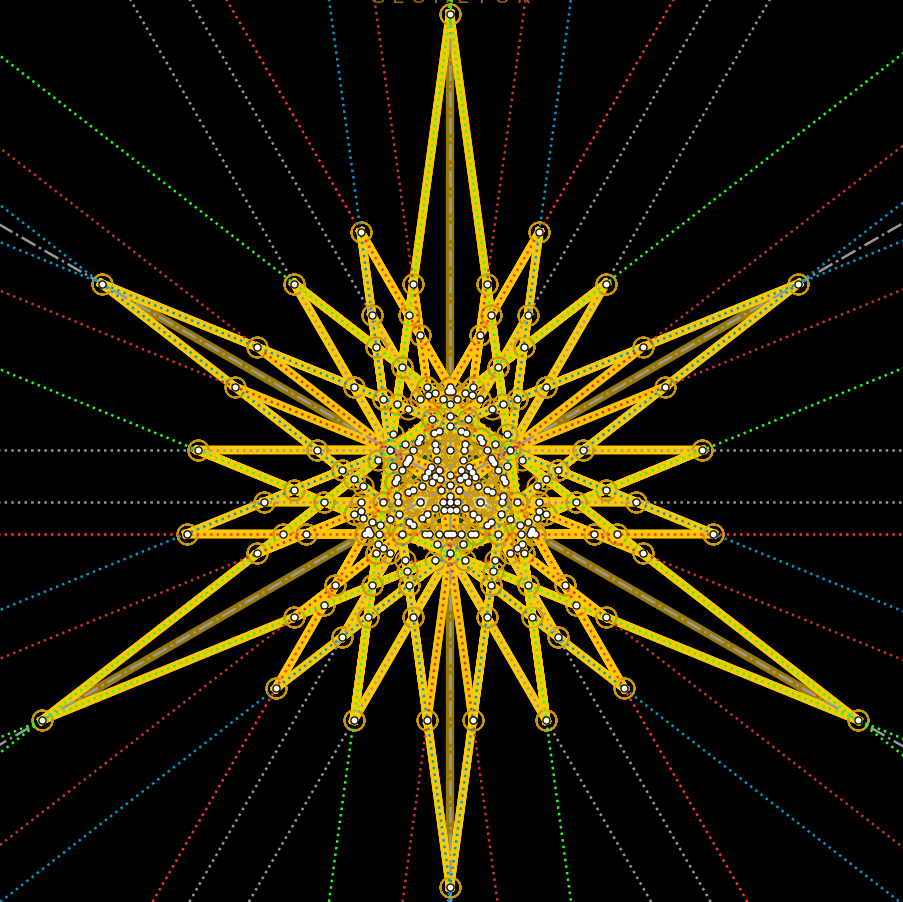
Statica Prolegomena · Historical & Mathematical Commentary¶
1. Al-Mu’taman ibn Hūd (11th Century) vs. Ceva’s Static Revolution (1678)¶
For three centuries Giovanni Ceva was universally regarded as the sole discoverer of the concurrency criterion $\frac{AF}{FB}\cdot\frac{BD}{DC}\cdot\frac{CE}{EA} = 1$. In 1985, historian Jan P. Hogendijk (1995) discovered that Yusuf al-Mu'taman ibn Hud (d. 1085), Hudid King of Zaragoza, had already proved the theorem synthetically in his Arabic Kitāb al-Istikmāl (Book of Perfection) by iterated applications of Menelaus's transversal theorem.
Because Kitāb al-Istikmāl was never translated into medieval Latin, Ceva’s 1678 discovery in Milan was completely independent—and methodologically far more radical. Where al-Mu’taman worked inside classical Greek proportion theory, Ceva invented barycentric statics: assigning algebraic masses $(u : v : w)$ to points so that incidence theorems reduce to associative vector addition over $\mathbb{Q}$.
2. Donato Rossetti, the Court of Mantua & Ludovico Monza’s Milan Printing House¶
Ceva’s Prooemium and Dedicatio reveal the vibrant institutional matrix of late seventeenth-century northern Italian mathematics:
Donato Rossetti (1633–1686): Rossetti, Canon of Livorno and professor of mathematics at Pisa, was an early disciple of the Galilean school and an influential proponent of atomistic mechanics. His Pisan lectures directly inspired Ceva to fuse statics with geometry.
Ferdinando Carlo Gonzaga (1652–1708): The tenth and last Duke of Mantua, whose court provided patronage to artists, engineers, and mathematicians across Lombardy before the War of the Spanish Succession.
Ludovico Monza’s Typographic Innovations: Monza operated a major academic printing press in seventeenth-century Milan, renowned for mathematical typesetting. His typographic notice clarifying
A † FandF - Aensured that Ceva’s algebraic notation would not confuse readers accustomed to Euclidean prose.