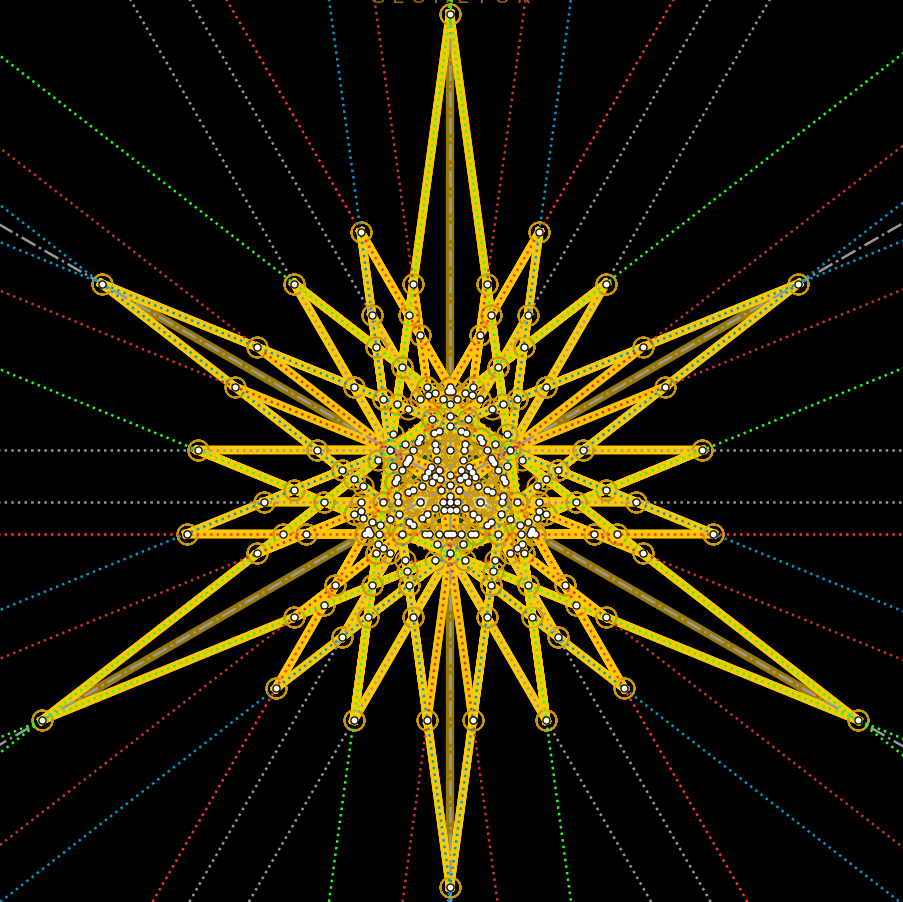
Book II · Circumscribed Conics, Isotomic Conjugates & Odd Polygons (pp. 45–72)
Original GEOMETOR English translation from Giovanni Ceva’s De lineis rectis se invicem secantibus statica constructio (Milan: Ludovico Monza, 1678, Liber Secundus, Lemma I & Props. I–XIV, pp. 45–72; Scans 0062–0089; Tab. 4–7, Figs. 32–61).
1. Lemma I — Borelli–Serenus Cylindrical Ellipse Projection (pp. 45–47)
Opening Liber Secundus (Tab. 4, Figs. 32–35), Ceva proves a master projective-affine lemma for polygons circumscribed about circles and ellipses:
Circle Case: Let any polygon of $n$ sides (whether $n$ be odd or even) be circumscribed around a circle circleC. Since the two tangents drawn from each exterior vertex $V_k$ to the circle have equal lengths $t_k$ ([III.36]), the contact points $T_0, T_1, \dots, T_{n-1}$ divide the consecutive sides into segments $(t_0, t_1), (t_1, t_2), \dots, (t_{n-1}, t_0)$ whose cyclic compound ratio is identically $1$:
$$\frac{t_0}{t_1} \cdot \frac{t_1}{t_2} \cdots \frac{t_{n-1}}{t_0} = 1.$$
Ellipse Case via Cylindrical Section: Now erect a right or oblique circular cylinder upon circleC and cut it by an oblique plane (projCyl), producing an arbitrary Apollonian ellipse ellipseE, as demonstrated by Serenus of Antinoöpolis (1566) and Giovanni Alfonso Borelli (1661). Because parallel generator lines along the cylinder map every tangent side $V_k V_{k+1}$ to a tangent side $V'_k V'_{k+1}$ of the ellipse and preserve the ratio of collinear segments ([VI.2]), any $n$-gon circumscribed about an ellipse also has its sides divided at the contact points in cyclic compound ratio $1$ (sectio cylindrica)!
2. Prop. I & Corollarium — Contact Point $X(7)$ & Isotomic Conjugate $X(8)$ (pp. 47–50)
Applying Lemma I to a triangle ABC circumscribed around an inscribed circle incircle (or any inscribed ellipse), Proposition I (pp. 47–49, Tab. 4, Figs. 36–37) establishes immediately by Liber Primus, Prop. VII that the three cevians AD, BE, CF drawn to the points of contact concur at a single point X(7)—published by Ceva in 1678, 140 years before Joseph Diez Gergonne (punctum contactus)!
Immediately afterward, in Proposition I *Corollarium*, Ceva discovers isotomic conjugation (coniugatum isotomicum): if on each side of triangle ABC we transfer the contact distances to the opposite ends—choosing D*, E*, F* so that $BD^* = DC$ (BDeq), $CE^* = EA$ (CEeq), and $AF^* = FB$ (AFeq)—then each side ratio is inverted to its reciprocal, so their compound product remains $1^{-1} = 1$, and the three reflected cevians AD*, BE*, CF* concur at the reciprocal center X(8) (rediscovered by Christian Heinrich von Nagel in 1836)!
3. Props. II–XIV — Multilateral Odd $(2m + 1)$-gon Concurrency (pp. 50–72)
In Propositions II–XIV (Tab. 4–7, Figs. 38–61), Ceva generalizes cevian concurrency and conic tangency from triangles to multilateral polygons of odd side count $n = 2m + 1$ (pentagons pentagon, heptagons, enneagons). Whenever rays (cev0, cev1, cev2, cev3, cev4) from the $2m + 1$ vertices (V0..:g:V4) pass through a common concurrency center P to meet their opposite sides at (Q0..:g:Q4), static weight transfer across the vertex-to-opposite-side bipartite cycle proves that the cyclic product of the $2m + 1$ opposite-side division ratios equals $+1$:
$$\prod_{i=0}^{2m} \frac{\overline{V_{i+m} Q_i}}{\overline{Q_i V_{i+m+1}}} = 1.$$