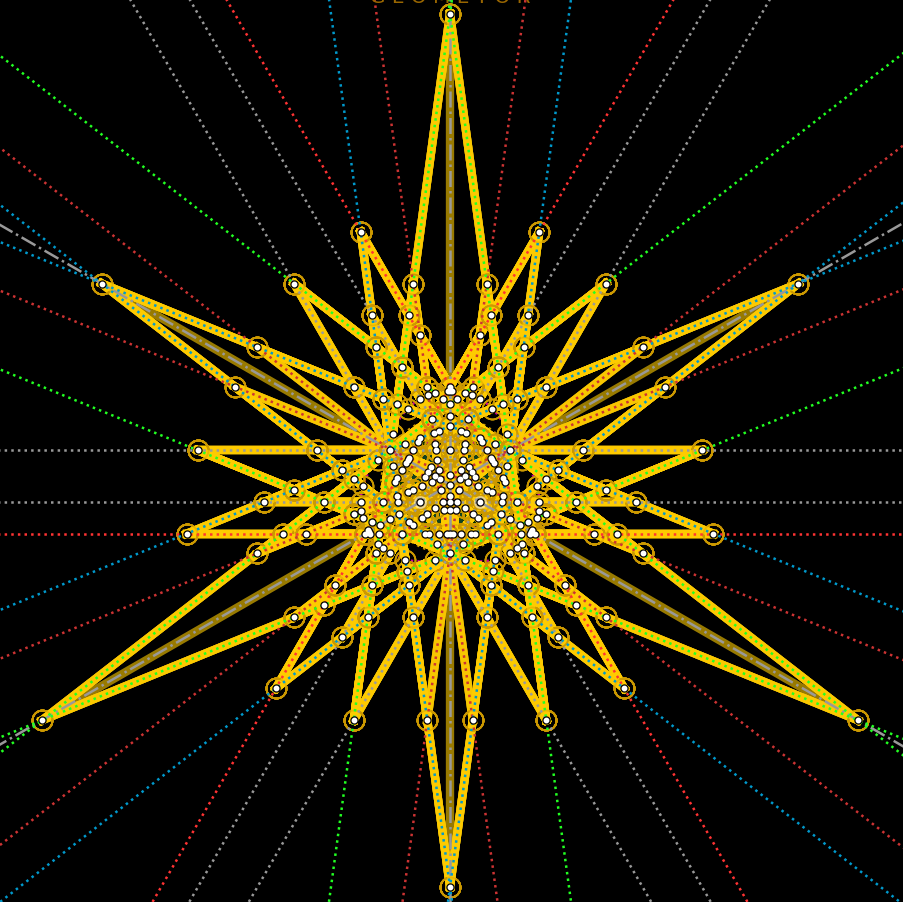
John Casey
Role: Irish Geometer, Professor of Higher Mathematics at the Catholic University of Ireland, Fellow of the Royal University of Ireland, F.R.S.
Historical & Geometric Context: Born May 12, 1820, in Kilbehenny, County Limerick; died January 3, 1891, in Dublin. Casey stands alongside George Salmon, Richard Townsend, and Robert Stawell Ball at the summit of the nineteenth-century Dublin school of pure geometry. Educated first in local Munster schools and largely self-taught in higher mathematics while serving as headmaster of the Kilkenny Central Model Schools, Casey entered Trinity College Dublin as a pensioner in 1858 at the age of thirty-eight—having already communicated original discoveries on the geometry of the triangle and circle to Richard Townsend and George Salmon. Electing Scholarship in 1861 and graduating B.A. in 1862, he subsequently served as Professor of Higher Mathematics and Mathematical Physics at the Catholic University of Ireland (from 1873) and Fellow of the Royal University of Ireland (from 1882), elected Fellow of the Royal Society in 1875.
In 1861, as an undergraduate (Quarterly Journal of Pure and Applied Mathematics 4, pp. 245–252), Casey discovered his celebrated three-line circular-inversion proof of Feuerbach’s Theorem—inverting the incircle and the $A$-excircle into themselves from the midpoint $M_a$ of $BC$ with squared radius $\frac{1}{4}(b - c)^2$ so that the fourth common tangent maps directly onto the nine-points circle. In 1866 (Proceedings of the Royal Irish Academy, vol. 9, pp. 396–423), he published his famous generalization of Ptolemy’s Theorem for four circles tangent to a fifth. His Sequel to Euclid (1st ed. 1881; 4th ed. 1886 adding the Supplementary Chapter; 5th ed. 1888; 6th ed. 1892) introduced generations of English-speaking students worldwide to inversion, coaxal circles, poles and polars, and Lemoine–Brocard modern triangle geometry.
GEOMETOR Website: John Casey
GitHub Repository: https://github.com/geometor/casey