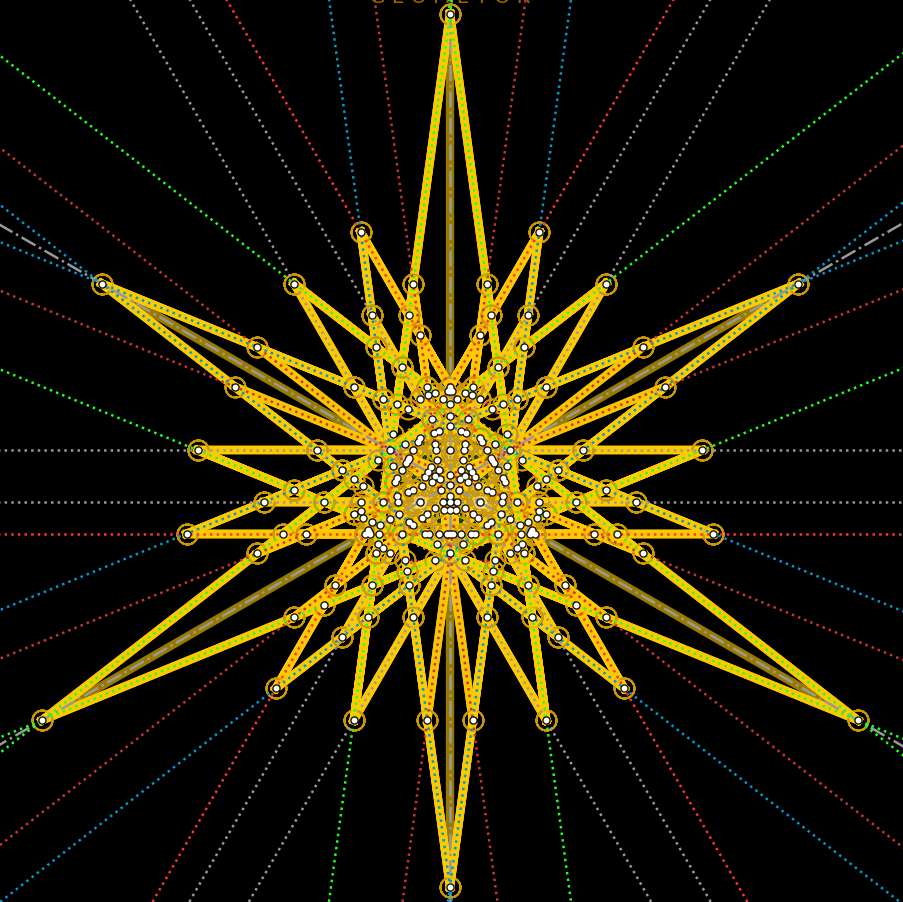
Summary — Chapter L: The Continuity of Space (§§ 416–422)¶
Primary Text: Read Verbatim Treatise Track (pp. 437–444) · Commentary: Critical Notes
Executive Summary¶
Chapter L (The Continuity of Space, §§416–422, pp. 437–444) integrates Cantor’s ordinal continuity (Part V) into projective and metrical geometry. Russell formulates projective continuity via Dedekind’s axiom on harmonic quadrants (§416), metrical continuity via Archimedes and Dedekind cuts (§417), notes that continuity suffices to prove Euclid’s circle-intersection existence theorems though Hilbert showed a weaker algebraic field suffices (§418), critiques empirical geometry (§420), and concludes against monistic tradition that continuous space is literally an infinite aggregate of points (§422).
Argumentative Architecture¶
flowchart LR
            A["§§416–417 Projective & Metrical Continuity"] --> B["§§418–419 Circle Intersection & Hilbert's Surd Sub-Space"]
            B --> C["§§420–421 Empirical Premisses Need Not Assume Continuity"]
            C --> D["§422 Space as Cantor Aggregate of 2^α₀ Points"]
Key Arguments & Theses¶
§§418–419: Circle Postulate vs. Full Continuity¶
Continuity implies the intersection of lines and circles assumed tacitly in Euclid I.1, yet Hilbert proved that Euclidean compass-and-straightedge constructions require only a countable quadratic-surd subfield (GEOMETOR’s exact algebraic domain!).
§420: Critique of Approximate Empirical Geometry¶
Anticipating Hoenen’s problem of exactitude from the opposite direction, Russell remarks that sense-perception yields only finite margins of error, whereas pure geometry treats exact hypothetical spaces.
§422: Space as an Infinite Aggregate of Points¶
Rejecting the Aristotelian–Kantian dictum that points are mere limits of division, Russell insists that Cantor’s set theory rehabilitates space as a literal class of $2^{\alpha_0}$ indivisible points.