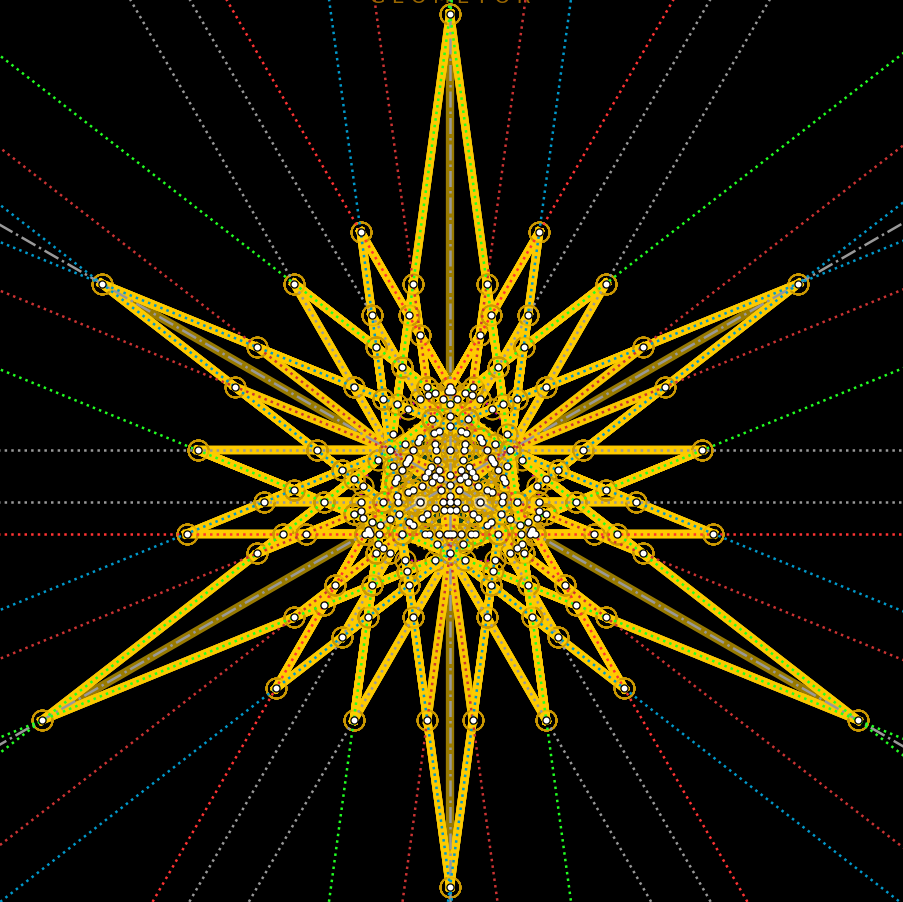
Aristotle’s Four Pillars of Geometric Cognition
Synthesizing Mathematical History (Heath) and Scholastic Noetics (Hoenen)
Loci Geometrici et Noetici organizes fifty-four Aristotelian chapters into five Libri corresponding to the four structural pillars that sustain classical constructive geometry.
I. Apodeixis & First Principles (Organon)
In Posterior Analytics I.1–13 (Liber I.A), Aristotle demonstrates that scientific knowledge (epistēmē) cannot regress infinitely nor move in a circle. Every demonstrative science rests upon three distinct kinds of indemonstrable starting-points (72a14–24, 76a31–77a4):
Common Axioms (axiōmata): Principles presupposed by all reasoning, such as “if equals be taken from equals, the remainders are equal”—adopted by Euclid as the Common Notions.
Nominal Definitions: Understanding what a term signifies (e.g., unit, straight, triangle), without yet assuming existence.
Existential Hypotheses & Constructive Postulates (aitēmata): Positing the primary subjects (points and lines) and licensing elementary compass-and-straightedge constructions from which all composite figures are proved to exist without contradiction.
Equally decisive is Aristotle’s requirement of commensurate universality (katholou, An. Post. I.4–5, 73b25–74b4): proving 2R separately for equilateral, isosceles, and scalene triangles fails to capture the true middle term, whereas Eudoxus's general theory of proportion (Elements V, Def. 5) grasps alternation at its exact level of intelligible generality.
II. Continuous Magnitude & Potential Infinity (Physica & De Caelo)
In Categories 6 (4b20, Liber II.A) and Physics III–VI (Liber III.A & Liber III.B), Aristotle severs discrete multitude (arithmos) from continuous magnitude (megethos). Two quantities are continuous when their extremities are one; therefore no line can ever be composed of unextended points (stigmai, Phys. VI.1, 231a21–b18).
Simultaneously, Physics III.6–7 (206a9–208a4) resolves the antinomies of Zeno of Elea and guarantees Euclidean constructibility: the infinite (apeiron) exists potentially by division, never as a completed infinite body, assuring geometers that any finite segment can be bisected or cut in extreme and mean ratio indefinitely.
III. Common Sensibles & the Spatial Phantasm (De Anima III)
How do non-empirical geometric necessities enter human thought? In De Anima III.3–8 (Liber IV), Aristotle shows that magnitude, figure, number, movement, and rest are common sensibles (aisthēta koina, 418a17, 428b22) perceived across sight and touch and preserved by imagination (phantasia) as spatial phantasms (phantasmata). Crucially, “the soul never thinks without a phantasm” (431a16), and “the faculty of thinking thinks the forms in the phantasms” (τὰ μὲν οὖν εἴδη τὸ νοητικὸν ἐν τοῖς φαντάσμασι νοεῖ, 431b2)—even when drawing a determinate foot-long segment while reasoning solely about its universal linearity (De Memoria 449b30, An. Post. I.10 76b39).
IV. Intelligible Matter & Diagrammatic Actuality (Metaphysica Z, Θ, M)
Finally, Metaphysics Z.10–11, Θ.9, and M.1–3 (Liber V.B) supply the ontological counterpart to De Anima:
Intelligible Matter (hylē noētē,
1036a9–12): When abstraction (aphairesis) strips away sensible qualities (heat, weight, color), pure continuous extension remains as the individuating substrate enabling two congruent circles or triangles to be numerically distinct while sharing one definition.Diagrammatic Discovery in Act (energeia,
1051a21–33): Latent geometric truths—such as the interior angles of a triangle equaling two right angles (Elements I.32) or the angle in a semicircle being universally right (Elements III.31)—become immediately transparent to intellectual vision (noēsis) the instant the geometer actualizes the latent division by drawing the auxiliary parallel or radius.