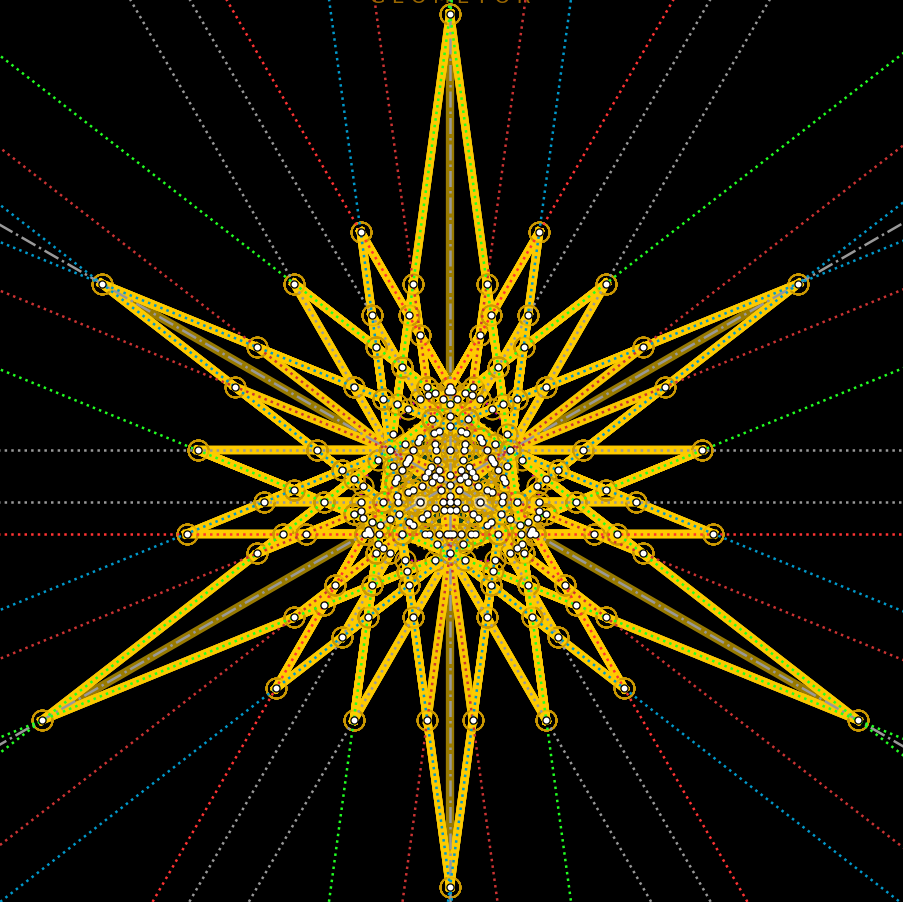
Books VI & VII — Equal and Similar Conics & Conjugate Diameters
Preserved alongside Book V in Thābit ibn Qurra's Arabic translation (Halley 1710), Books VI and VII complete the extant treatise: Book VI establishes the invariants of congruence, similarity, and 3D cone embedding, while Book VII crowns ancient geometric algebra with Apollonius’s Theorems on Conjugate Diameters and the inequality diorismoi built for the lost Book VIII.
1. Book VI — Equal & Similar Conics and Cone Embedding [Props. 114–122 / VI. 1–33]
Book VI opens with six explicit Definitions (p. 197): two conics are equal (ἴσαι) when one can be applied to the other so as everywhere to coincide, and similar (ὅμοιαι) when ordinates drawn to the axis at proportional distances from the vertex are everywhere proportional to their abscissae.
Universal Similarity of Parabolas [Prop. 115 / VI. 11]: All parabolas are similar to one another (scaling all lengths by the ratio of their latera recta maps one onto the other).
Criterion for Similar Central Conics [Prop. 116 / VI. 12–13]: Two ellipses or two hyperbolas are similar if and only if the characteristic figures on their axes are similar rectangles (, i.e. equal eccentricity!). Parabolas, ellipses, and hyperbolas are mutually dissimilar (VI.14–15).
Cutting Any Given Conic from Any Given Right Cone [Props. 120–122 / VI. 28–30]: Given any right circular cone and any prescribed parabola (VI.28), hyperbola (VI.29), or ellipse (VI.30), Apollonius constructs the exact cutting plane—proving that a single right cone suffices to generate every possible parabola and ellipse, and every hyperbola whose asymptotic angle does not exceed the cone’s vertical angle!
2. Book VII — Apollonius’s Conjugate Diameter Theorems [Props. 123–147 / VII. 1–51]
Using two ingenious focal-like auxiliary points HH laid off along the principal axis AA such that (Props. 123–128 [VII. 1–11]), Apollonius reduces the lengths of any pair of oblique conjugate diameters PP () and DD () to pure focal-style segments along the axis, proving his two celebrated invariance theorems:
Plate 10 — Apollonius’s Conjugate Diameter Theorems (Book VII.12, 13, 31 [Props. 129 & 136]). On an ellipse with semi-axes , and any oblique conjugate semi-diameters , inclined at angle : (1) ; (2) the circumscribed tangent parallelogram LLMM has constant area .
Proposition 129 [VII. 12, 13, 29, 30] — Apollonius’s First Theorem (Quadratic Trace Invariance). In every ellipse the sum, and in every hyperbola the difference, of the squares on any two conjugate diameters PP, DD is equal to the sum or difference respectively of the squares on the principal axes AA, BB:
Proposition 136 [VII. 31] — Apollonius’s Second Theorem (Circumscribed Parallelogram Area Invariance). If PP, DD be conjugate diameters of an ellipse or of conjugate hyperbolas, and tangents drawn at their extremities PPDD form the circumscribed parallelogram LLMM, its area is invariant and equal to the rectangle contained by the principal axes:
3. Extrema of Conjugate Functions for Book VIII [Props. 131–147 / VII. 21–51]
Propositions 131–147 [VII. 21–51] establish monotonic variations and global maxima/minima for , , parameter , and as P moves from major vertex A to minor vertex B (e.g., Prop. 133 [VII. 25–26]: attains its unique maximum on an ellipse at the equal conjugate diameters, and its minimum at the axes ), ending at Proposition 147 [VII. 51] (pp. 253–254).