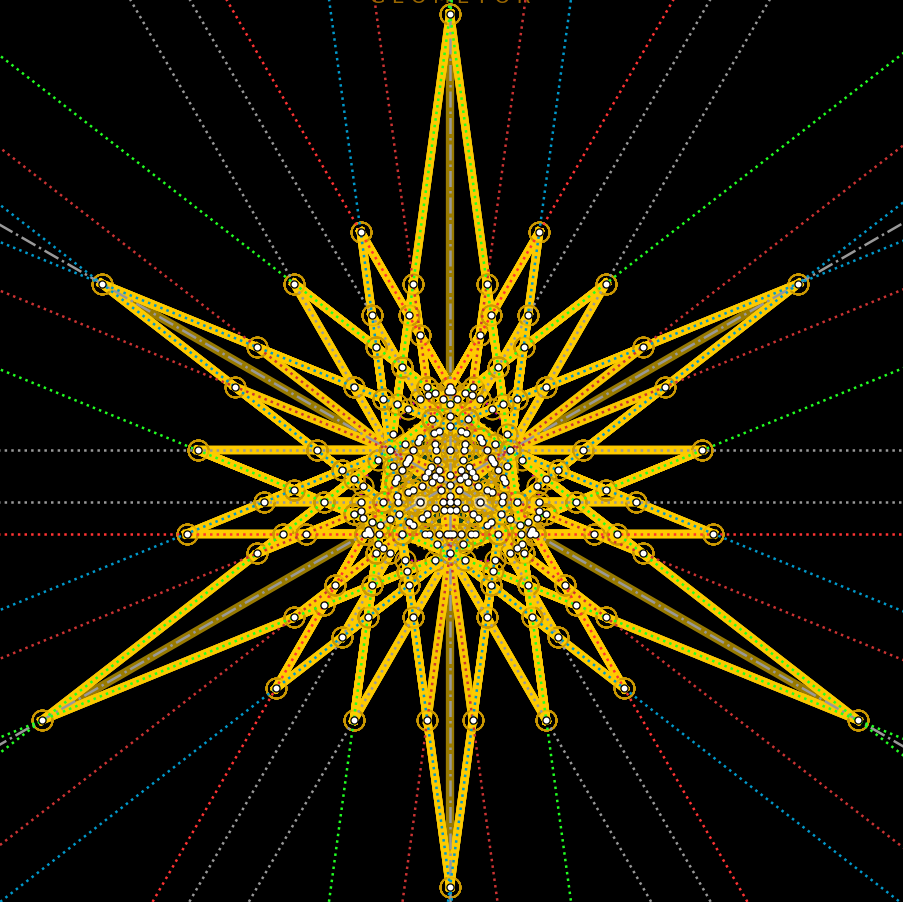
Book VII: Conjugate Diameter Theorems & Extrema
Propositions 123–147 [Classical VII. 1–51] — Apollonius of Perga (ed. T. L. Heath, 1896)
Book VII crowns ancient geometric algebra with Apollonius’s celebrated Theorems on Conjugate Diameters: the quadratic trace invariance () and the determinant parallelogram area invariance (). It then establishes the exhaustive series of inequality diorismoi constructed as the solvability machinery for the lost Book VIII.
Sections
1. Apollonius’s Conjugate Diameter Theorems [Props. 123–136 / VII. 1–32]
Proposition 129 [VII. 12, 13, 29, 30] — Apollonius’s First Theorem (Quadratic Trace Invariance). In every ellipse the sum, and in every hyperbola the difference, of the squares on any two conjugate diameters PP, DD is equal to the sum or difference respectively of the squares on the principal axes AA, BB:
2. Extrema of Conjugate Functions for Book VIII [Props. 131–147 / VII. 21–51]
Propositions 131–147 [VII. 21–51] establish monotonic variations and global maxima/minima for , , parameter , and as P moves from major vertex A to minor vertex B (e.g., Prop. 133 [VII. 25–26]: attains its unique maximum on an ellipse at the equal conjugate diameters, and its minimum at the axes ), ending at Proposition 147 [VII. 51] (pp. 253–254).