Book II — Asymptotes, Conjugate Hyperbolas & Secant Intercepts
1. Construction & Non-Meeting of the Asymptotes [Props. 28–29 / II. 1–2, 15, 17, 21]
Book II opens with the geometric construction of the asymptotes (αἱ ἀσύμπτωτοι) of a hyperbola, its opposite branch, and its conjugate hyperbolas from the characteristic figure of any diameter PP:
Proposition 28 [II. 1, 15, 17, 21] — Construction of the Asymptotes. (1) If PP be a diameter of a hyperbola and the corresponding parameter, and if on the tangent at P there be set off on each side equal lengths PL, PL such that
then CL, CL produced from the center C will not meet the curve in any finite point and are accordingly defined as asymptotes. (2) The opposite branches have the same asymptotes. (3) Conjugate hyperbolas (having DD as transverse diameter and PP as secondary diameter) share the exact same asymptotes.
2. Secant Intercepts, Bisected Tangents & the Asymptotic Equation [Props. 30–35 / II. 3–16]
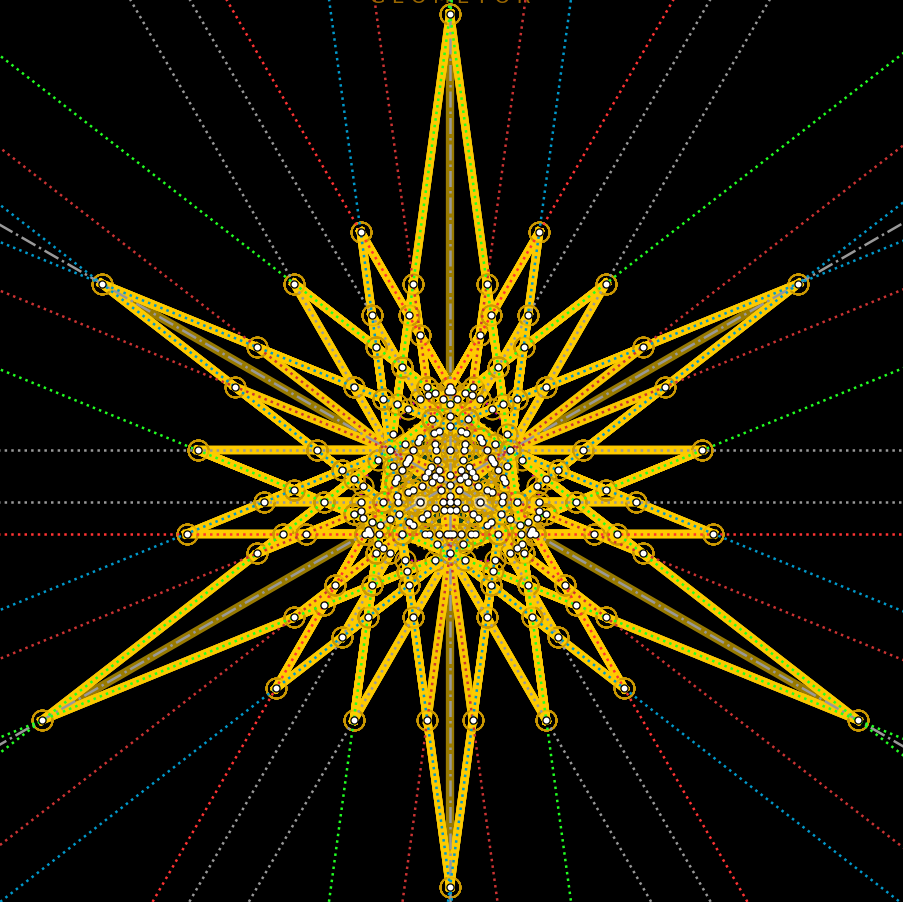
Plate 4 — Asymptotes, Conjugate Hyperbolas & Equal Secant Intercepts (Book II.1–21 [Props. 28–38]). Both conjugate hyperbolas share asymptotes CL, CL; any tangent segment LL between the asymptotes is bisected at its point of contact P; any secant meeting the hyperbola at QQ and the asymptotes at RR cuts off equal intercepts with .
Bisected Tangent Segment [Prop. 30 / II. 3, 9]: If a straight line touch a hyperbola at P and meet the asymptotes in LL, then LL is bisected at P (), and .
Equal Secant Intercepts [Prop. 33 / II. 8, 10, 16]: If any straight line meet a hyperbola in QQ and its asymptotes in RR (whether across a single branch or across opposite branches), the outer intercepts between curve and asymptotes are strictly equal:
\[RQ = Q'R' \qquad \text{and} \qquad RQ \cdot QR' = PL^2 = b'^2,\]where PL is the half-tangent parallel to the secant ([II.5], [II.6]).
Asymptotic Coordinate Equation [Prop. 34 / II. 12]: If from any two points Q, q on a hyperbola straight lines QMQN and qmqn be drawn in given directions to meet the two asymptotes, the rectangles contained by those asymptotic coordinates are equal:
\[QM \cdot QN = qm \cdot qn \qquad \bigl(x y = \text{const.}\bigr).\]Arbitrary Closeness without Contact [Prop. 35 / II. 14]: The asymptotes and the hyperbola, when produced indefinitely, approach continually nearer to one another and eventually come within a distance less than any assigned length ([X.1]).
3. Finding Diameters, Axes & Tangents by Compass and Straightedge [Props. 47–53 / II. 44–53]
In the closing chapters of Book II (II.44–53), Apollonius solves the fundamental problems of geometric recovery on a ready-drawn conic arc whose cone and parameters are unknown:
Finding a Diameter & Center (`II.44–45 [Props. 47–48]`): Bisecting two parallel chords gives a diameter; intersecting two non-parallel diameters gives the center C.
Finding the Principal Orthogonal Axes (`II.46–48 [Props. 49–50]`): For the parabola, dropping a chord perpendicular to the found diameter locates the unique axis; for a central conic, describing a circle around C intersecting the conic in KH yields the two orthogonal axes bisecting KH and its supplement ([III.3]).
Drawing Tangents from Any Point (`II.49 [Prop. 51]`): Given an external point T, Apollonius constructs the contact points QQ via harmonic division on the diameter through T ( for central conics; for the parabola), proving that at most two tangents pass through T.